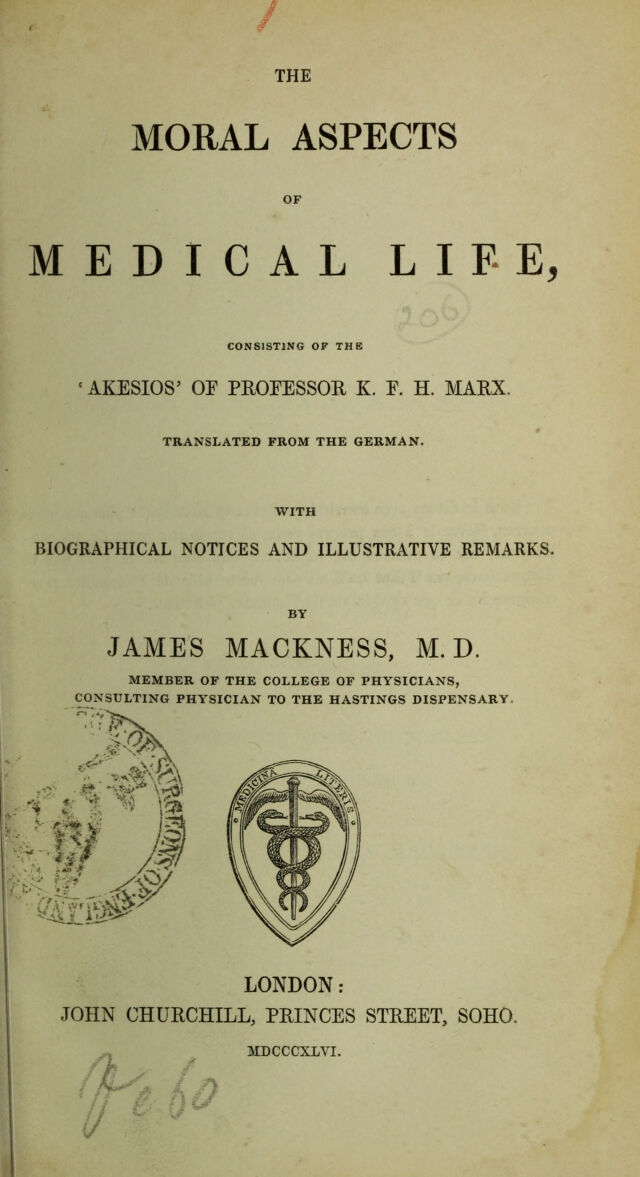
The moral aspects of medical life / consisting of the Akesios of K.F.H. Marx ; translated from the German, with biographical notices and illustrative remarks, by James Mackness.
- Karl Friedrich Heinrich Marx
- Date:
- 1846
Licence: Public Domain Mark
Credit: The moral aspects of medical life / consisting of the Akesios of K.F.H. Marx ; translated from the German, with biographical notices and illustrative remarks, by James Mackness. Source: Wellcome Collection.
Provider: This material has been provided by The Royal College of Surgeons of England. The original may be consulted at The Royal College of Surgeons of England.
38/362 page 24
![A belief in the marvellous is the more excusable, con- sidering how little the intellect even of the wisest can grasp. The aj)pearance of some great benefactor to man- kind in an unfeeling age, the raising up of Napoleon in an abandoned age, are wonders as great as the fact that the willow-worm has more than 40G1 muscles,* * * § and the crab a propensity to somnambulism.f ‘‘ Physicians truly ought to favour the simplest modes of explanation, and to interpret appearances by physical laws, that they may thereby unmask the impostor and defend the innocent. ‘‘Hast thou, indeed, learned that it was the physician Edward Jordan who, in the sixteenth century, exposed the notorious Anna Gunter, and showed that she exhibited her extraordinary paroxysms merely to bring the suspicion of witchcraft on a neighbour whom she hated.:]: “ Was not that an admirable declaration of Theodore Mayerne (who died in 1655, aged 82, having been the physician of four kings), when he averred that demoniac possession was only to be credited in the case of an un- educated man being able to $kpress himself with propriety ^ on scientific subjects, and to sustain his body for some time floating in the atmosphere ?§ ^ “What poor thanks, at times, physicians earn by their * Whoever doul)ts this may have ocular demonstration in Lyonnet’s ‘ Anatomical Treatise’ (Traite Anatomique de la Chenille.) Blumen- ti l bach remarks in his ‘ Comparative Anatomy,’ 2d edit. p. 439, that it liti has ten times as many as there are in the human body, and nearly as many again as there are parts in a stocking-frame. t llenneman shows in his estimable treatise, ‘ The Crab a Somnam- ' bulist,’in Hufeland’s Journal, 1823, Art. 5, p. 19, that the walk of the crab through the simple application of the stroking of the hand, or through breathing on the back, slackens, and at last movement entirely ceases. X J. Aikin’s Biographical Memoirs. Lond. 1780, p. 232. § Ibid. p. 263.](https://iiif.wellcomecollection.org/image/b22316188_0040.jp2/full/800%2C/0/default.jpg)