Actes du onzième Congrès international des orientalistes. Paris--1897.
- International Congress of Orientalists
- Date:
- 1898-1899
Licence: Public Domain Mark
Credit: Actes du onzième Congrès international des orientalistes. Paris--1897. Source: Wellcome Collection.
48/298 page 34
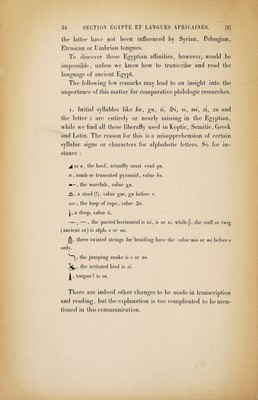
![the latter have not been influenced by Syrian, Pelasgian, Etruscan or Umbrian tongues. To discover these Egyptian affinities, however, would he impossible, unless we know how to transcribe and read the language of ancient Egypt. The following few remarks may lead to an insight into the importance of this matter for comparative philologie researches. 1. Initial syllables like ku, yu, ti, Q-i, si, mi, zi, zu and the letter z are entirely or nearly missing in the Egyptian, while we find all these liberaliy used in Koptic, Semitic, Greek and Latin. The reason for this is a misapprehension of certain syllabic signs or characters for alphabetic letters. So for in¬ stance : ^ or ■*, the hoof, actually must read qu. m , tomb or truncated pyramid, value ku. , the warcluh, value )(U. ZÛ, a stool (?), value )(ur, yu before r. , the loop of rope, value S-i. ], a drop, value ti, the parted horizontal is isi, is or si, while p, the staff or twig (ancient za) is alph. s or sa. (|j, three twisted strings for braiding have the value mis or mi before s only. , the jumping snake is 2; or za. , the irritated bird is zi, ^ , tongue ? is zu. There are indeed other changes to be made in transcription and reading, but the explanation is too complicated to be men¬ tioned in this communication.](https://iiif.wellcomecollection.org/image/b30094057_0050.jp2/full/800%2C/0/default.jpg)
 No text description is available for this image
 No text description is available for this image
 No text description is available for this image