Licence: Attribution-NonCommercial 4.0 International (CC BY-NC 4.0)
Credit: Families in trouble / Earl Lomon Koos. Source: Wellcome Collection.
128/164 page 106
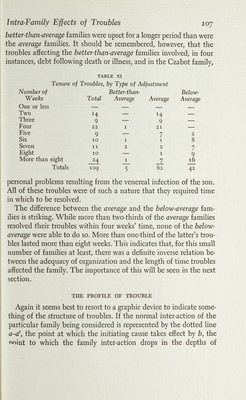
![io6 Families in Trouble Among the families for whom the sex act had always been more unemotional and perfunctory, there was a tendency to decrease the frequency during trouble. I don't know—when we have any trouble I don't bother the old lady. When you are in trouble, [sexual intercourse] just ain't worth the bother. She quit playing after we'd been married two years, and unless I ask her we just don't, and I don't think about asking her when I'm in a jamb. The wife's attitude in this latter group was well-stated in the words of Mrs. Wemer: I just don't seem to care about that anymore when we have trouble. It seems my mind is on other things and I can't accept it like I used to. So I say No, please don't, when he asks me. There was, in all probability, considerable rationalization by this woman and by the others to whom the sex act (after the first few months of marriage, at least) was an unsatisfactory experience, either because of a fear of pregnancy or because of the unemotional quality of the relationship. The general impression gained was, however, that sex activity was diminished except where it was orig¬ inally a rich, satisfying experience which gave special strength to the husband-wife relationship. THE TENURE OF TROUBLE Directly related to the effect of trouble upon the family was the length of time that trouble continued. Table XI iiidicates the rela¬ tion between the two.® It appears immediately that there is little relation between type of adjustment and tenure of trouble, since the 8. The tenure of the trouble was the length of time a family experienced other than its usual pattern of behavior. Several factors were considered in arriving at these figures: the length of time of temporary shifts in dominance or role evaluation, the period during which the usual family action patterns were disturbed, and so on. In some instances the appearance of a new trouble brought the first one to a close (for our purposes here). These figures cannot be regarded as definitive—they are introduced as indicators of the length of time a family remains upset as a result of trouble.](https://iiif.wellcomecollection.org/image/b18024348_0129.JP2/full/800%2C/0/default.jpg)


 No text description is available for this image
 No text description is available for this image
 No text description is available for this image