The history of the first inebriate asylum in the world / by its founder [Jonathan Edward Turner]. An account of his indictment, also a sketch of the Woman's national hospital, by its founder.
- Turner, J. Edward, 1822-1889.
- Date:
- 1888
Licence: Public Domain Mark
Credit: The history of the first inebriate asylum in the world / by its founder [Jonathan Edward Turner]. An account of his indictment, also a sketch of the Woman's national hospital, by its founder. Source: Wellcome Collection.
68/512 (page 64)
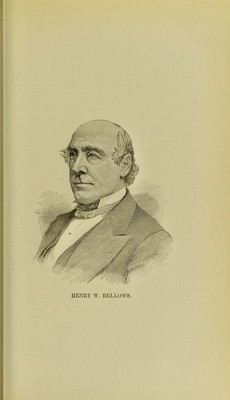
![ADDRESS OF REV. HENRY W. DELLOWS, D. D., DELIVERED AT THE BROADWAY TABERNACLE, NOVEMBER TtH, 1855, LV BEHALF OF THE UNITED STATES INEBRIATE ASYLUM. Ladies and Gentlenien :—Notwitlistaiiding’ the inimense and doubtless the greatly successful labors of the temperance cause, drunkenness, according to statistics that do not prob- ably reach more than half the dreadful truth, carries off fifty thousand citizens of the United States 3’early—the exact total by these tables being, for the last year, fifty-eight thousand seven hundred and eleven, and for the last ten years, four hundred and seventy-eight thousand two hundred and thirty- nine. We do not doubt the real number to be a million. Consider the immense ])roclivity of our people to this vice, when the jirodigious efforts to stay it leave such a sum of it unprevented and uncnred! The climatic, political, and moral causes of this terrible effect have never yet received due consideration. There is, unquestionably, a powerfully stimu- lating influence in our climate, which renders the human con- stitution here extraordinarily excitable, and gives to intoxi- cating liquors a charm and a peril which they have nowhere else. Foreigners uniformly assert the less need, and the greater power, of alcoholic drinks here than in Europe. But worse than our climate, is the political and social atmosphere in which our free institutions and our new conditions place us. The same stimulus, which makes our commercial and meclianical life of enterjirise, and swiftness, which hurries along our railroads and steam-ships, and devours the wilder- ness, gives a fearfulness of competition, a recklessness of haste, a, fever of the blood and the brain to our people, which makes them era vers of strong drinks—vast consumers of rich and exciting food, and of stimulating liquors. Almost all our successful citizens are taxed beyond their strength; are doing two or three men’s work, and are tempted to inebriety by their exhaustion, and the necessity of kee])ing up their s))irits to the mark. And then, of course, in this commercial stampede there are thousands of disa])])ointed conqietitors in the race, men weaker in the ]>ower of enter]u-ise, but often strongest in sweet and noble endowments, who are tranqiled beneath the hurrying crowd, and left to solace themselves with whatever they can find to cheer or drown their sorrows.](https://iiif.wellcomecollection.org/image/b24857014_0068.jp2/full/800%2C/0/default.jpg)