Successful case of staphylography [sic] / by James Young, M.D.
- Young, James
- Date:
- [1857]
Licence: Public Domain Mark
Credit: Successful case of staphylography [sic] / by James Young, M.D. Source: Wellcome Collection.
Provider: This material has been provided by The University of Glasgow Library. The original may be consulted at The University of Glasgow Library.
3/8
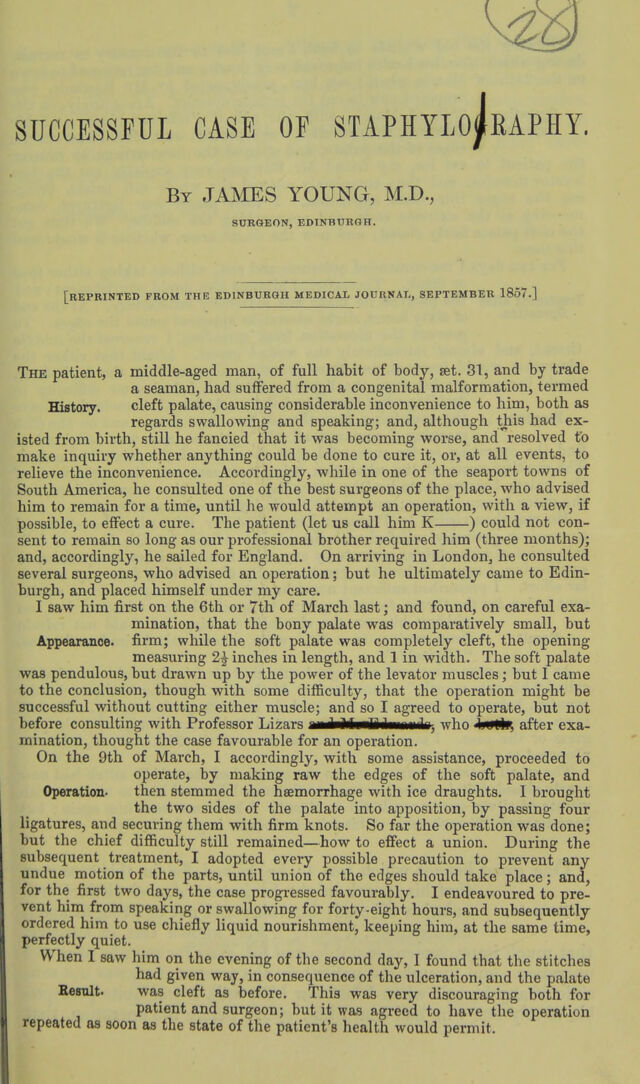
![SUCCESSFUL CASE OF STAPHYLOpAPHY. By JAMES YOUNG, M.D., SUKGEON, EDINRTIRRH. [reprinted from the EDINBURGH MEDICAL JOURNAL, SEPTEMBER 1857.] The patient, a middle-aged man, of full habit of body, set. 31, and by trade a seaman, had suffered from a congenital malformation, termed History. cleft palate, causing considerable inconvenience to him, both as regards swallowing and speaking; and, although tjiis had ex- isted from birth, still he fancied that it was becoming worse, and resolved to make inquiry whether anything could be done to cure it, or, at all events, to relieve the inconvenience. Accordingly, while in one of the seaport towns of South America, he consulted one of the best surgeons of the place, who advised him to remain for a time, until he would attempt an operation, with a view, if possible, to effect a cure. The patient (let us call him K ) could not con- sent to remain so long as our professional brother required him (three months); and, accordingly, he sailed for England. On arriving in London, he consulted several surgeons, who advised an operation; but he ultimately came to Edin- burgh, and placed himself under my care. I saw him first on the 6th or 7th of March last; and found, on careful exa- mination, that the bony palate was comparatively small, but Appearance, firm; while the soft palate was completely cleft, the opening measuring 2| inches in length, and 1 in width. The soft palate was pendulous, but drawn up by the power of the levator muscles; but 1 came to the conclusion, though with some difiiculty, that the operation might be successful without cutting either muscle; and so I agreed to operate, but not before consulting with Professor Lizars amiMmiUmmmd^, who 4f9li^ after exa- mination, thought the case favourable for an operation. On the 9th of March, I accordingly, with some assistance, proceeded to operate, by making raw the edges of the soft palate, and Operation. then stemmed the hsemorrhage with ice draughts. I brought the two sides of the palate into apposition, by passing four ligatures, and securing them with firm knots. So far the operation was done; but the chief difficulty still remained—how to effect a union. During the subsequent treatment, I adopted every possible precaution to prevent any undue motion of the parts, until union of the edges should take place; and, for the first two days, the case progressed favourably. I endeavoured to pre- vent him from speaking or swallowing for forty-eight hours, and subsequently ordered him to use chiefly liquid nourishment, keeping him, at the same time, perfectly quiet. When I saw him on the evening of the second day, 1 found that the stitches had given way, in consequence of the ulceration, and the palate Eesnlt. was cleft as before. This was very discouraging both for patient and surgeon; but it was agreed to have the operation repeated as soon as the state of the patient's health would permit.](https://iiif.wellcomecollection.org/image/b2147798x_0003.jp2/full/800%2C/0/default.jpg)