Description of a great sepulchral mound at Aylesbury-road, near Donnybrook, in the county of Dublin, containing human and animal remains, as well as some objects of antiquarian interest, referable to the tenth or eleventh centuries / by William Frazer.
- Frazer, William
- Date:
- [1879]
Licence: Public Domain Mark
Credit: Description of a great sepulchral mound at Aylesbury-road, near Donnybrook, in the county of Dublin, containing human and animal remains, as well as some objects of antiquarian interest, referable to the tenth or eleventh centuries / by William Frazer. Source: Wellcome Collection.
Provider: This material has been provided by The Royal College of Surgeons of England. The original may be consulted at The Royal College of Surgeons of England.
23/36 (page 49)
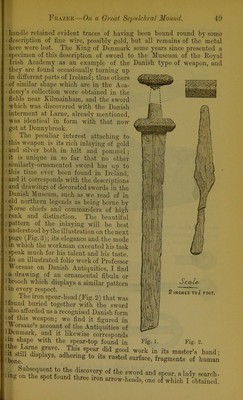
![handle retained evident traces of having been bound round by some I description of fine wire, possibly gold, but all remains of the metal here were lost. The Fing of Denmark some years since presented a specimen of this description of sword to the Museum of the Royal Irish Academy as an example of the Danish type of weapon, and they are found occasionally turning up in different parts of Ireland; thus others t of similar shape which are in the Aca- I demy’s collection were obtained in the fields near Kilmainham, and the sword which was discovered with the Danish interment at Lame, already mentioned, was identical in form with that now : got at Donnybrook. The peculiar interest attaching to this weapon is its rich inlaying of gold ;and silver both in hilt and pommel; it is unique in so far that no other similarly-ornamented sword has up to ' this time ever been found in Ireland, : and it corresponds with the descriptions : and drawings of def’orated swords in the . Danish Museum, such as we read of in ' old northern legends as being borne by Rorse chiefs and commanders of high ; rank and distinction. The beautiful ] pattern of the inlaying will be best ’ understood by the illustration on thenext ;pago (Fig. 3); its elegance and the mode . in which the workman executed his task ! speak much for his talent and his taste. In an illustrated foUo work of Professor ■^mrsaae on Danish Antiquities, I find ! a drawing of an ornamental fibula or 1 brooch which displays a similar pattern 1 in every respect. The iron spear-head (Fig. 2) that was : found buried together with the sword ^ also afforded us a recognised Danish form ^of this weapon; we find it figured in Morsaae’s account of the Antiquities of IDenmark, and it likewise corresponds '■r stmTsuHr;.1W “ its master’s hand; ‘bone ^ ^ ®ted surface, fragments of human ing ofthTsStW »earch- ng on the spot found three iron arrow-heads, one of which I obtained. 2 INCHES TOJ FOOT.](https://iiif.wellcomecollection.org/image/b2230759x_0023.jp2/full/800%2C/0/default.jpg)