Better services for the mentally handicapped / presented to Parliament by the Secretary of State for Social Services and the Secretary of State for Wales by command of Her Majesty, June 1971.
- Department of Health and Social Security
- Date:
- 1971
Licence: Open Government Licence
Credit: Better services for the mentally handicapped / presented to Parliament by the Secretary of State for Social Services and the Secretary of State for Wales by command of Her Majesty, June 1971. Source: Wellcome Collection.
17/76 page 11
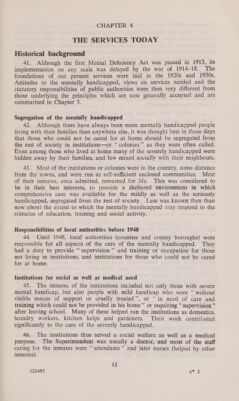
![THE SERVICES TODAY Historical background 41. Although the first Mental Deficiency Act was passed in 1913, its implementation on any scale was delayed by the war of 1914-18. The foundations of our present services were laid in the 1920s and 1930s. Attitudes to the mentally handicapped, views on services needed and the statutory responsibilities of public authorities were then very different from those underlying the principles which are now generally accepted and are summarised in Chapter 3. Segregation of the mentally handicapped 42. Although there have always been more mentally handicapped peopie living with their families than anywhere else, it was thought best in those days that those who could not be cared for at home should be segregated from the rest of society in institutions—or “colonies” as they were often called. Even among those who lived at home many of the severely handicapped were hidden away by their families, and few mixed socially with their neighbours. 43. Most of the institutions or colonies were in the country, some distance from the towns, and were run as self-sufficient enclosed communities. Most of their inmates, once admitted, remained for life. This was considered to be in their best interests, to provide a sheltered environment in which comprehensive care was available for the mildly as well as the seriously handicapped, segregated from the rest of society. Less was known then than now about the extent to which the mentally handicapped may respond to the stimulus of education, training and social activity. Responsibilities of local authorities before 1948 44, Until 1948, local authorities (counties and county boroughs) were responsible for all aspects of the care of the mentaliy handicapped. They had a duty to provide “supervision ” and training or occupation for those not living in institutions, and institutions for those who could not be cared for at home. Institutions for social as well as medical need 45. The inmates of the institutions included not only those with severe mental handicap, but also people with mild handicap who were “ without — visible means of support or cruelly treated”, or “in need of care and training which could not be provided in his home” or requiring “ supervision ” after leaving school. Many of these helped run the institutions as domestics. laundry workers, kitchen helps and gardeners. Their work contributed significantly to the care of the severely handicapped. 46. The institutions thus served a social welfare as well as a medical purpose. The Superintendent was usually a doctor, and most of the staff caring for the inmates were “attendants” and later nurses (helped by other inmates). 1]](https://iiif.wellcomecollection.org/image/b32230473_0017.jp2/full/800%2C/0/default.jpg)