Dr. Airy's report to the local government board on the sanitary state of the Knighton registration district (Radnorshire).
- Airy, Hubert.
- Date:
- 1878
Licence: Public Domain Mark
Credit: Dr. Airy's report to the local government board on the sanitary state of the Knighton registration district (Radnorshire). Source: Wellcome Collection.
Provider: This material has been provided by London School of Hygiene & Tropical Medicine Library & Archives Service. The original may be consulted at London School of Hygiene & Tropical Medicine Library & Archives Service.
3/12 page 3
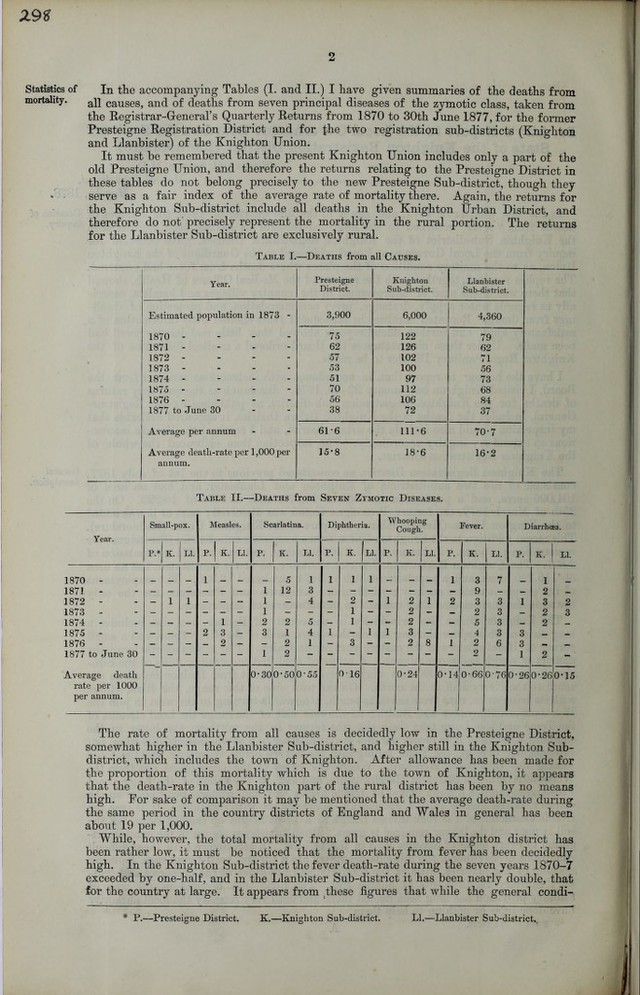
![3 tions of climate and occupation are favourable to life, they are partly neutralized by special conditions encouraging prevalence of fever. I must also point to the mor- tality from scarlet fever, diphtheria, whooping cough, and diarrhoea in the Knighton Sub-district; to that from scarlet fever in the Llanbister Sub-district; and to that from diarrhoea in the Presteigne District, as being higher than might be expected in a wholesome country region. I will now proceed to consider the Rural and Urban Districts separately. Knighton Rural Sanitary District. This comprises the]whole Union, with the exception of the contributory parliamentary Description, borough of Knighton, which forms an urban sanitary district. By the addition in 1877 of part of the former Presteigne Union (as already mentioned) the Knighton Rural Sanitary District has been considerably enlarged in area, and has received an accession of 2,607 to its former population of 8,580. Within the present limits of the district, the population in 1871 was 11,187, in 1861 it was 11,177. Since the last census the population has more probably diminished than increased, for many houses are standing empty in Presteigne, and the rural population generally is falling off. The Rural Sanitary Authority are the Board of Guardians of the Knighton Union. They meet once a fortnight. For purposes of sanitary supervision they have divided the district into three parts—(1) Beguildy and Llanbister, (2) Knighton and Brampton Bryan, (3) Presteigne. The first two comprise the whole of the district as it was prior to July 1877; but they do not correspond to the Llanbister and Knighton Registration Sub-districts. The third includes the whole of the portion recently added to the union, and corresponds to the new Presteigne Registration Sub-district. The Medical Officers of Health (under the Order of the Board, 11th November 1872) for the above-named three divisions of the rural sanitary district are (1) C. J. Covernton, Esq., at a salary of 351.; (2) H. 0. Brown, Esq., at a salary of 201.; (3) W. Hanson, Esq., at a salary of 201. For the whole rural district as it was before July 1877, the office of Inspector of Nuisances is held (at a salary of 401.) by Mr. T. Gough, who was appointed in April 1875. An additional Inspector, Mr. J. Mackenzie, has been appointed to the new Presteigne division, at a salary of 151. The Knighton Rural Authority have not applied for any urban powers, nor have they framed any byelaws for their district. I have already described the main features of the district and the character of the population. With the exception of the town of Presteigne, there is no parish or township in the district containing more than 1,000 persons. Besides Presteigne, there are 28 parishes and townships, with an average of 331 inhabitants to each. Part of this population is gathered in little villages which lie along the course of the principal streams; the remainder are scattered in hamlets and farmsteads and single cottages up in the dingles and among the hills. The older and poorer dwellings, whether in the plain or among the hills, are usually Dwellings, walled with clay and wattle-work in a strong frame of timber. In exposed situations the clay walls are often seen faced with planks stretched horizontally and overlapping one another, so as to shed the rain, but it is very rare to find any protection against the soaking of rain water at the foot of the wall. The shaly rock found in the district affords poor building stone, except at certain spots where it is quarried for the better class of buildings. It is usual, however, even in the poorest cottage, to build the chimney stack of stone, and this is often the most substantial part of the whole struc- ture, and encloses a very large low-browed fireplace. The roof is usually of thatch, and when carefully laid will last without need of repair for eight or nine years; at the end of that time, unless the thatch is entirely renewed, its partial renewal becomes a regular annual duty, which should be performed in autumn to meet the needs of winter. On one of the largest estates in the union the landlord, or rather the landlord’s agent, requires his tenants themselves to keep the thatch in good repair. The duty (whose ever it is) is often neglected, or very imperfectly performed. I must make special mention of a small farm-house, once a good one, called Lower Cott. The thatch has rotted and fallen into the bedroom, leaving holes that a man could get through. The rain comes through in numberless places, blackening the walls with the stain from the sodden thatch and flooding the room below. The rafters are broken or rotted from the walls ; cloths and matting are hung tentwise, to shelter the tenants of two beds in this room. Outside all is filth and ruin. Pigs wallow in the roofless back kitchen, and the refuse of the house is thrown at large before the door. A notice was served on the owner in November 1877, requiring him to repair the roof. The case was again reported to the Sanitary Authority in January 1878. No further order was made.](https://iiif.wellcomecollection.org/image/b24996099_0005.jp2/full/800%2C/0/default.jpg)