A text-book of organic chemistry / by A.F. Holleman ; edited by A. Jamieson Walker ; assisted by Owen E. Mott ; with the co-operation of the author.
- Arnold F. Holleman
- Date:
- 1913
Licence: In copyright
Credit: A text-book of organic chemistry / by A.F. Holleman ; edited by A. Jamieson Walker ; assisted by Owen E. Mott ; with the co-operation of the author. Source: Wellcome Collection.
559/646
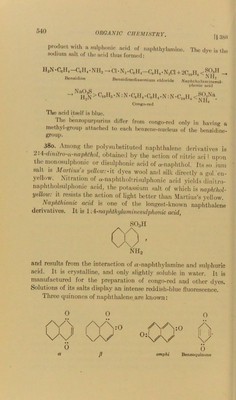
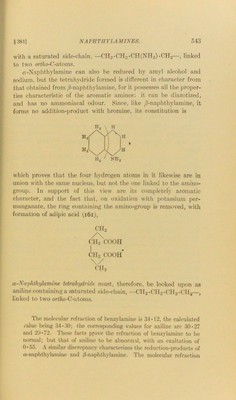
![§ 379] NAPHTHALENE SUBSTITUTION-PRODUCTS. can be reduced to an amino-group, which is replaceable by numer- ous atoms or groups by means of the diazo-reaction. If a mono- substituted naphthalene is known to be an a-compound, its iso- meride must belong to the ,3-scries. a-Nitronaphthalene is a yellow, crystalline compound, and melts at 01°. The corresponding ^-compound is similar, and melts at 79°. It is obtained by diazotizing 2-nitro-a-naphthyl- amine. On heating naphthalene with concentrated sulphuric acid at a temperature not exceeding 80°, a-naphthalenemonosulphonic acid is chiefly formed: at 100° the /3-acid is the principal product, owing to the conversion of the a-compound into its /3-isomeride. Both are crystalline and very hygroscopic. On fusion with caustic potash, the naphthalenesulphonic acids are converted into naphthols, Ciollz-OH, with properties very simi- lar to those of phenol. They are present in coal-tar. a-Naplithol melts at 95°, and boils at 282°: fi-naphthol melts at 122°, and boils at 288°. The hydroxyl-group in these compounds can be replaced much more readily than that in phenol. They dissolve in alkalis. With ferric chloride a-naphthol yields a flocculent, violet precipi- tate: /3-naphthol gives a green coloration, and a precipitate of ■3-dinaphthol, HO*Cioli,;*CjoIIo*OH. The violet precipitate obtained with a-naphthol is possibly an iron derivative of a-dinaphthol. a-.V'<phthylamine and 3-naphthylamine, C10II7 • NTT>, can be obtained by the reduction of the corresponding nitro-derivatives, but are usually prepared by heating a-naphthol and /3-naphthol respectively with the ammonia compound of zinc chloride or of calcium chloride. a-Naphthylamine is a solid and is also formed by heating naphthalene with sodamide, NH2Na, above 200°, hydrogen being evolved. It melts at 50°, and has a faecal-like odour: /3-naphthylamine melts at 112°, and is nearly odourless. A mode of distinguishing bet ween the isomerides is afforded by the fact that the salts of the a-compound, but not the /3-compound, give a blue precipitate with ferric chloride and other oxidizing agents. These bases are of technical importance, since the dyes of the congo-group and the benzopurpurins arc derived from them, and pos- sess the important property of dyeing unmordanted cotton. Congo-red is formed by diazotizing benzidine, and treating the](https://iiif.wellcomecollection.org/image/b28134424_0559.jp2/full/800%2C/0/default.jpg)
 No text description is available for this image
 No text description is available for this image
 No text description is available for this image