A text-book of organic chemistry / by A.F. Holleman ; edited by A. Jamieson Walker ; assisted by Owen E. Mott ; with the co-operation of the author.
- Arnold F. Holleman
- Date:
- 1913
Licence: In copyright
Credit: A text-book of organic chemistry / by A.F. Holleman ; edited by A. Jamieson Walker ; assisted by Owen E. Mott ; with the co-operation of the author. Source: Wellcome Collection.
583/646
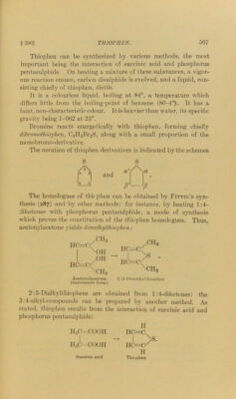
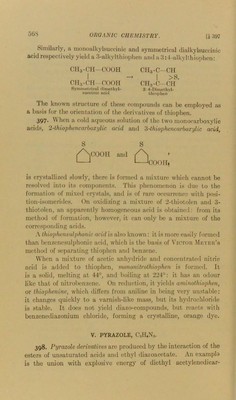
![§ 393] 5G3 Furfuraldehyde thus results from the elimination of three molecules of water under the influence of hydrochloric acid or sulphuric acid. It is a colourless, oily liquid of agreeable colour, and boils at 162°. A test for it is described in 207. Analogous to the conversion of pentoses into furfuraldehyde is that of ketohexoses into hydroxy methyl furfuraldehyde, HC—CH II II H IIO-CIH-C c*c“ \/ 0 o effected by heating with dilute acids. The structure of this sub- stance is proved by its oxidation to the dibasic dehydromucic acid, IIC—CH II II HOOC-C C *00011. \/ o Heating with hydrochloric acid or dilute sulphuric acid converts hydroxymethylfurfuraldehyde almost quantitatively into formic acid and Isevulic acid: C,.IIc03+2II20 =11 •COOH+CJHO,. Hydroxymethv!- Licvulic furfuraldehyde* acid The formation of hydroxymethylfurfuraldehyde is the cause of certain reactions exhibited by the hexoses. When heated with resorcinol and concentrated hydrochloric acid, it yields a dark-red precipitate. This reaction serves to distinguish the artificial honey made from invert-sugar (209) from the natural product, since in the inversion of the sucrose by heating with dilute acid a small proportion of hydroxymethylfurfuraldehyde is formed. As its name indicates, pyromucic acid is formed by the dry dis- tillation of mucic acid (211). It can also be obtained by oxidiz- ing furfuraldehyde with silver oxide. It is crystalline, melts at 132°, can be readily sublimed, and dissolves freely in hot water. When heated at 27*j° in a sealed tube, it yields carbon dioxide and furan.](https://iiif.wellcomecollection.org/image/b28134424_0583.jp2/full/800%2C/0/default.jpg)
 No text description is available for this image
 No text description is available for this image
 No text description is available for this image