An expository lexicon of the terms, ancient and modern, in medical and general science; including a complete medico-legal vocabulary / by R.G. Mayne.
- Mayne, Robert Gray, 1808-1868
- Date:
- 1860
Licence: Public Domain Mark
Credit: An expository lexicon of the terms, ancient and modern, in medical and general science; including a complete medico-legal vocabulary / by R.G. Mayne. Source: Wellcome Collection.
Provider: This material has been provided by The University of Glasgow Library. The original may be consulted at The University of Glasgow Library.
165/1540
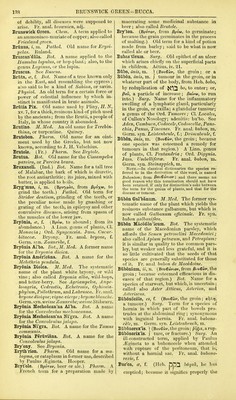
![Erooklime. ill. Bled. The common name for the plant Veronica beccabunga. Broom. (Sax. jSrom.) M.Med. The common name for the plant Spartium ncoparium. Fr. anal, genet, f. Germ. syn. Geniste, f. Broom, Spanish. Bot. Common name for the Spartium jimceum. Broom-Rape. Bot. Common name for the geuus Orobanche. Brosunum, i, n. (Bpiiinjuos, eatable.) A Linn. genus of plants, CI. Dimcia; Ord. Monan- dria. Brosimum Alicas'tnim. Bot. The systematic name of the tree which yields the bread- nut. Brouqxiiclions. Bot. A name for the Hydnum auriscalpium. Brow. (Sax. Bredw.) Anat. The superior portion of the face, from the eyes upwards ; the forehead. Frons, tis, m. Fr. syn. front, m. Germ. syn. Stirn, m. Brow-A'gue. Pathol. A popular term for severe pain, often of an intermittent cha- racter, and frequently situated just above the eyebrow. Brown. (Sax. Brun.) Chem., Nat. Philos. The familiar colour so named. Fuscus, a, urn. See Badius, Brunneus, Castaneus, Ferrugineus. Brown Mush'room. Bot. The common name for the Agaricus cinnamomeus. Brown Stud'y. Med. Common tei-m for ApJielxia otiosa. Brucea, «, f. (— Bruce, the traveller in Abys- synia, who brought the seeds from that cotrati-y.) A Linn, genus of plants, CI. DicBcia; Ord. Tetrandria. Juss. Terebin- thacecB. Fr. anal, brucee, f. Brucea Antidysenterlca. ]Bot. Names for an Brucea Ferrugin'ea. f African tree, called in Abyssinia Wooginoos, having a bitter and astringent bark, esteemed as a remedy in dysentery and diarrhoea. Brucea Pseu'do-Ferrugln'ea. Bot. Systematic name for the tree supposed to yield the false Angustura hark ; it is but little known and is often confounded with the £./errw ginea. Brucia. See Brucin. Brucin'. Chem. Term for a vegetable alkali discovered in the barkof theBntcea^scitrfo- ferruginea, or tree supposed to yield the false Angustura bark; and m the Nux vomica. Briicia, or Bi-ucina, ce, f. See Diss, div. ii. s. vi. t. 4. Fr. anal, brucine, f. Bruise. (Sax. £?-i/san, to braise.) Surg. A contusion, which, in every case, is attended by the rupture of an infinite number of small vessels, and an extravasation of blood in a greater or less degree, the tone of the fibres and vessels which have suffered con- tusion being considerably disordered. Con- tusio, onis, f. See Sarcothlasis. Fr. syn. contusion, f.; meurtrissure, f. Germ. syn. Quetschung, f.; Zerstossung, f. Bruisewort. Bot. Common name for the Saponaria officinalis. Fr. syn. saponaire, f. Germ. syn. Seifenkraut, n. Bniissement, (Fr.) Med. Corvisart's term for the sound called Purring tremor, or the Frimissement cataire of Laennec, Bruit. (Fr. a noise, or rei^ort.) Patliol. Ap- plied to the difierent conditions of the noise or sound perceived by means of the stetho- scope, according as the thorax or its organs are affected by disease. Germ. syn. Ge- rdusch, n. Bruit de Diable. Pathol. The devil's noise; a term for a sound or murmur produced by the circulation in the veins, being usually confined to the internal jugulars, and more especially to the right one; believed to be caused by diminution of the mass of the blood: so named after a French toy, which produced a somewhat similar sound. Bruit de Frottement. Pathol. The sound, or noise of friction, heard when the pleura pulmonalis, or \hepleura costalis,\s, become rough to any considerable degree. Bruit de Kape. Pathol. The soimd of the rasp, as if a piece of wood were subjected to the action of a rasp; it indicates con- traction of the orifices of the heart, from disease of the valves. Bruit de Scie. Pathol. The sound of the saw, similar to the bruit de rape, but more rough, both being most generally indicative of a diseased state of the valves, causing con- traction of the orifices of the heart. Bruit de Soufflet. Pathol. The sound of the bellows, heard in cases of enlargement of the heart, or of contraction of its orifices, and passing by insensible gradations into the bruit de rape, and bruit de scie; all three originating from the same causes. Brumalis, is, e. [BrUma, the midst of winter.) Pertaining to the midst of winter, or to the shortest day; applied to certain plants (Brumalesplantcs, nom. pi. f.) which fiowtr in the season corresponding to om* winter: bru'mal. Fr. syn. hyemal, adj. Geim. syn. tvinterlich, adj. Briuuasar. (Arab.) An alchemical term for Argentum, or Luna. See Soloma. Brumati, Old term for a glass vessel. Euland. Brumelli. Bot. A name for the Fraxinus excelsior, or ash. Brunella. See Prunella. Brun'ner's Glands. Anat. A term for the G/a«duZiKsoZiteri£f, or solitary glands; being the mucous follicles discovered by Brunner in the cellular tunic between the villous and muscular coats of the intestinal canal. Glandulce Brunnerii. Fr. anal, glandcs de Brunner. Brun'neus, a, um. Chem., Nat. Philos. Of a deep dark brown colour. Bruno'nian. Med. Apphed to a system of the practice of physic, formed by Dr. John Brown, a Scotch physician, and cotemporary of Cullen, consisting in the assumption that the body possesses a peculiar property of excitability; that eveiy agent capable of acting on it during life, does so as a stimu- lant ; that these stimulants (or the excite- ment caused by them) when they are duly in exercise, produce the healthy perform- ance of the natural functions; that when excessive, they produce exhaustion, or direct debility ; when deficient, the effect is an accumulation of excitabihty, or indirect debility ; from one or other of which states IS](https://iiif.wellcomecollection.org/image/b21462124_0165.jp2/full/800%2C/0/default.jpg)