An expository lexicon of the terms, ancient and modern, in medical and general science; including a complete medico-legal vocabulary / by R.G. Mayne.
- Mayne, Robert Gray, 1808-1868
- Date:
- 1860
Licence: Public Domain Mark
Credit: An expository lexicon of the terms, ancient and modern, in medical and general science; including a complete medico-legal vocabulary / by R.G. Mayne. Source: Wellcome Collection.
Provider: This material has been provided by The University of Glasgow Library. The original may be consulted at The University of Glasgow Library.
42/1540 page 14
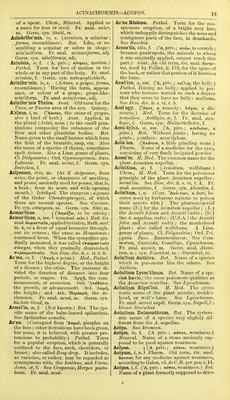
![off or prevent weaiiness, believed to be the Menyunthes trifoliata, or buck-hean. A'cor, (</-(s, m. (.^eer, sbai*p.) Pathol. Term lor sourness, acidity, or acrimony, as in the stomach from indigestion. Fr. syn. Acid- iie, f. Germ. syn. Saure, f. Acoria, «, f. ('A, priv.; KopEo), to satiate.) Pa- thol. Anotlier term, as usually rendered, for Bulimia, or voracious appetite. Fr. anal. acorie, f. Germ. syn. Unersdttllchkeit, f. Note.—CastelUis ileiiiJes tliis explanation as most ftljsui'd, conteniliuy that the term was used by Hippo- crates to signify tiiat eating, sliort of satiely, and diligence and alacrity in Inbonr, are, or shew, the Bound exercise of ln-allh : and ho seonis riglit, for tlie a of the etymon simply denotes tlhniniition, and this moditics the word, so that it merely means good ajjpe- tilo and digestion. Acijrites, cb, m. (^Axopov, the plant Aconis.) Med. Ancient name for a wine impregnated by the qualities of the Acorus, liquorice, etc. Acortun, ?, n. I CA/fopoy, the sweet-smelling Acor^is, I, in. / flag.) The former pharmaco- pii'ial name (L.18;j(i) for the plant Acorus ca- /amus,orsweetflag. A Linn, genus of plants, C]. Ile.vandria; Ord.Monotjynia. Juss.^roi- de(c. See Diacorum. Fr. anal, acore, m. Acortis Calamus. 21. Med. The systematic name of the sweet-scented flag; also called A. Asiaticus, and A. Verus. See Calamus Aromaticus ; Clava rw/osa, Diringa, Typha aromatica. Fr. anal, acore rrai,m. Germ, syn. Kalmus, m. Acorus Adulterinus. Bot. A name for tlie Iris pKctidacorus. Acorus Asiaticus. M. Med. Another name for the Acorus calamus. Aconis Palus'tris. Bot. Another name for the Iris pseudacorus, or I. palustris. Acorus Verus. M. Med. Another name for the Acorus calamus. A'ccs. (Akoj, from a.K€onai, to cure.) Med. An old tenia for a medicine, or a cure; a healing. See Acesis. Acos'mia, a, f. ('A, priv.; Koaixiw, to adom.) A disturbed state of things. 3Ied. Gr. anal. aKoafila, applied by Galen in prcenot. Hipp. iii. 7, to irregularity in the ciitical days of fever, as k6<tixos signified their regularity; also applied to baldness, because it destroys the ornament of the hair, KSa^os signifying adornment, as well as order or regularity. AcotyleioneviS, a, run.) (Acdti/lrdon, a plant Acotyledonus, o, wm. J having no seed-lobe.) Bot. Of or belonging to the acotyledones ; haring no cotyledon or seed-lobe : acotyle- don'eous; acotyle'donous. See Cotyledon. Fr. syn. acotyledon, or acotyledone, adj. Germ. syn. ohiie Samenlappen; samenlap- penlos, adj. Note.—The antepenult, and penult syllables of these two words is short, consistently with tl\e Greek root. KuTu\ri56v()S, the genitive case of KorvKn^aiv. AcStyledon, 6nis, f. ( A, priv.; kotuAtjSoiv, 6yos, a seed-lobe.) Bot. Term for a plant having ho seed-lobe: without a cotyledon; apjjlied to a division {Acotyledones, nom. pi.) of the Juss. sj'stem. See Note, Cotyledon. Fr. anal, acotyledon, or acotyledone, m. Germ, syn. ohne samenlappen. Acou'meter. {'Axouw, to hear; fierpov, a mea- siu-e.) Nat. Philos. Name given to an in- slrtiment for estimating the power or extent of the sense of hearing. Acoumetrtan, i, n. Fr. anal, acoumetre, m. Acous'ma, ntis, n. (AKovana, the thing which is hearil; from aKuia, to hear.) Pathol. Term for a species of depraved hearing, in which sounds are imagined as if they were really hcarrl. Acous tic. ('A/cou(r7))s aliearer; terminal-wbs.) Physiol. Of or belonging to the ear, as the organ of hearing, or to sound, or the sense of hearing. Med., Pharm. Anciently ap- jilied to remedies (acoustica medicamenta,) for deafness. Acoustlcus, a, um. See iJlss. div. ii. s. 0. t. (i. Fr. syn. Acoustique, adj. Germ. syn. akustisch, adj. Acous'tic Duct. Anat. Another term for the Meatus auditorius. Acous'tic Nerve. A7iat. A name for the audi- tory nerve, or Partio mollis of the seventh pair. Acous'tics. ('AKoiJa), to hear.) Nat. Philos. A term for the doctrine of the theory and principles of sound. Acoustica, ce, f. I'r. anal, acoustique, m. Germ. a,n&\.Akustik,t'. Acquisitiveness, (Acqurro, to ohtam.) Phre- nol. Term for a faculty common to man and the lower animals (its organ at the an- terior inferior angle of the parietal bone.) prodticing the tendency to acquire properly, and the desire to possess in general, with- out reference to the uses to which the objects may be applied. Acrae'palos. 1 (^KKpai-raXos, from o priv.; Acrae'palus, a, um.) KpanrdM], drunken or glut- tonous excess.) Having power to correct the effects of excess in eating or diinking, according to Dioscorides, i. 25. Acrae'palvun. (Same as in Acreepalos.) Med., Pharm. Old name applied to a medicine to correct the effects of excess in eating or drinking. Nom. sing. n. oi Acrcepalus. Acrai. {Arab.) Pathol. A word denoting a certain degree of mitation of the genital system of either sex; held to be a species of Satyriasis, according to Avicenna, iii. 21, tr. i. c. 5, and 0. Acralea. Same derivation and meaning as Acrea, which see. Acrania, a, f. ('A, priv.; Kpaviov,\\\e cranium.) Physiol. Term for that species of defec- tive developement consisting in the partial or total absence of the cranium. Fr. anal. cranie, f. Acrasia, ce, f. ('A, priv.; /cpSo-is, a dtie mix- ture.) Med. Term, Gr. anal. oKpoirio, used by Hippocrates, de Humor, iii. 110, for incontinence, or intemperance in food, drink, or any other thing; excess; also applied to weakness, or inability to move; or to want of tone, and so like Acratcia. Acratei'a, f.) ('A, priv.; Kparos, strength.) Acratia, a, f. ] A term, Gr. anal. hcpaTna, used by Hippocrates, Coac. prcenot. 477.; Aph. V. 16, for debility, impotence, or in- efficiency. See Acrasia. Fr. sjna. acratie, f. Germ. syn. Kraftlosigkeit, f.; Ohnmacht, f. Acratis'ma, fitos, n.) ( AKpan'f'ai, to breakfast, Acratis'mus, i, m. 3 from &KpaTo%, pure; be- cause the breakfast of the ancient Greeks consisted of bread soaked in pure, or un- mixed wine.) Old term for the breakfast of](https://iiif.wellcomecollection.org/image/b21462124_0042.jp2/full/800%2C/0/default.jpg)