Volume 2
A dictionary of Greek and Roman geography / by various writers ; edited by William Smith.
- Date:
- 1873
Licence: Public Domain Mark
Credit: A dictionary of Greek and Roman geography / by various writers ; edited by William Smith. Source: Wellcome Collection.
23/1428 (page 3)
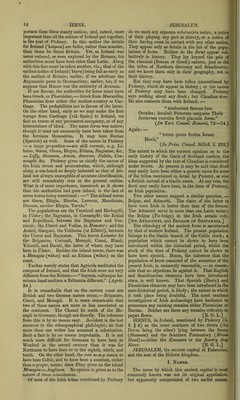
![lAMISSA. Orycluma 'vras the same as the fort Achaia, which is said to have been the first settlement of the He- liadae in the island (Diod. Sic. v. 57; Athen. viii. p. 360); at any i-ate, Achaia was situated in the territory of lalysus, which bore the name lalysia. (Comp. Horn. II. ii. 656; Find. 01. vii. 106; Herod, ii. 182 ; Thucyd. viii. 44 ; Ptol. v. 2. § 34; Steph. iB. s. V.-, Scylax, Peripl. p. 81; Dionys. Perieg. 504; iOv. Met. vii. 365; Pomp. Mela, ii. 7.) The bite of ancient lalysus is still occupied by a village bearing I the name laliso, about which a few ancient remains 'are found. (Ross, Eeisen auf den Grieck. Inseln, jvol. iii. p. 98.) [L. S.] lAMISSA. [Thamesis.] I lAMNA, lAMNO. [Baleakes, p. 374, b.] lAMNIA (Tagj'^s, LXX.; 'Idpvia, 'idfiyela ’U/ulad), a city of the Philistines, assigned to !the tribe of Judah in the LXX. of Joshua xv. 45 l(repi'a) ; but omitted in the Hebrew, which only mentions it in 2 Chron. xxvi. 6 (Jabneh in the English version), as one of the cities of the Philis- tines taken and destroyed by king Uzziah. It is celebrated by Philo Judaeus as the place where the first occasion was given to the Jewish revolt under- Caligula, and to his impious attempt to profane the temple at Jerusalem. His account is as follows: — In the city of lamnia, one of the most populous of Judaea, a small Gentile population had established itself among the more numerous Jews, to whom they occasioned no little annoyance by the wanton vio- lation of their cherished customs. An unprincipled government officer, named Capito, who had been sent to Palestine to collect the tribute, anxious to pre-occupy the emperor with accusations against the Jews before their well-grounded complaints of his boundless extortion could reach the capital, ordered an altar of mud to be raised in the town for the dei- fication of the emperor. The Jews, as he had antici- pated, indignant at the profanation of the Holy Land, assembled in a body, and demolished the altar. On hearing this, the emperor, incensed already at what had lately occuri-ed in Egypt, resolved to resent this insult by the erection of an equestrian statue of Uiimself in the Holy of Holies. (Philo, de Legal, ad fCaium, Op. vol. ii. p. 573.) With respect to its site, it is assigned by Josephus to that part of the tribe of Judah occupied by the children of Dan (^Ant. v. 1. § 22) ; and he reckons it as an inland city. (^Ant. xiv. 4. § 4, B. J. i. 7. § 7.) Thus, likewise, in the 1st book of Maccabees (x. 69, 71), it is spoken of as situated in the plain country ; but the author of the 2nd book speaks of the harbour and fleet of the lamnites, which were fired by Judas Mac- cabaeus; when the light of the conflagration- was seen at Jerusalem, 240 stadia distant. The appa- rent discrepancy may, however, be reconciled by the notices of the classical geographers, who make fre- quent mention of this town. Thus Pliny expressly says, “ lamnes duae; altera intus,” and places them between Azotus and Joppa (v. 12); and Ptolemy, having mentioned 'lapvqTwv, “the port of the lam- nites,” as a maritime town between Joppa and Azotus, afterwards enumerates lamnia among the cities of Judaea. From all which it is evident that lamnia had its Majuma, or naval arsenal, as Gaza, Azotus, and Ascalon also had. (Le Quien, OHens Christ, vol. iii. col. 587, and 622.) The Itinerary of Antoninus places it 36 M. P. from Gaza, and 12 M. P. from Diospolis (or Lydda); and Eusebius (^Onom. s. V. '\dg.veia') places it between Diospolis and Azotus. Its site is still marked by ruins which lAPODES. 3 retain the ancient name Yehna. situated on a small eminence on the west side of Wady Rubin, an hour distant from the sea. (Irby and Mangles, Travels, p. 182.) “ The ruins of a Roman bridge,” which they noticed, spanning the Nalir-el-Rubin between Yebna and the sea, was doubtless built for the pur- pose of facilitating traflSc between the town and its sea-port. [G. W.] lAMPHORlNA, the capital of the Llaedi, in Ma- cedonia, which was taken b. c. 211 by Philip, son of Demetrius. (Liv. xxvi. 25.) It is probably repre- sented by Vranid or Ivorina, in the upper valley of the Mordva. (Leake, Northern Greece, vol. iii. p. 473.) [E. B. J.] lANGACAUCA'NI [Mauketania.] JANUA'RIA ('Jarovapia &Kpa), a promontory on the coast of Cilicia, near Serrepolis, between ]\Iallus and Aegaea. (Stadiasm. §§ 149, 150.) It is now called Karadash. [L. S.] lA'PIS (’laTTts), a small stream which formed the boundary between Megaris and the territory of Eleu- sis. [Attica, p. 323, a.] lA'PODES, lA'PYDES (’IdwoSey, Strab. iii. p. 207, vii. p. 313 ; ’laTruSes, Ptol. ii. 16. § 8; Liv. xliii. 5 ; Vii-g. Georg, iii. 475 ; Tibull. iv. 1. 108), an Illyrian people to the N. of Dalmatia, and E. of Liburnia, who occupied Iapydia (Plin. iii. 19), or the present military frontier of Croatia, com- prised between the rivers Kulpa and Korana to the N. and E., and the Vekbich range to the S. In the interior, their territory was spread along Mons Albius {Velika), which foi-ms the extremity of the great Alpine chain, and rises to a great ele- vation ; on the other side of .the mountain they reached towards the Danube, and the confines of Pannonia. They followed the custom of the wild Thracian tribes in tattooing themselves, and were armed in the Keltic fashion, living in their poor country (like the Morlxxcchi of the present day) chiefly on zea and millet. (Strab. vii. p. 315.) In B. c. 129, the consul C. Sempronius Tuditanus carried on war against this people, at first unsuc- cessfully, but afterwards gained a victory over them, chiefly by the military skill of his legate, D. Junius Brutus, for which he was allowed to celebrate a triumph at Rome (Appian, B. C. i. 19, Illyr. 10 ; Liv. Epit. lix. ; Fasti Capit.') They had a “ foedus” with Rome (Cic. ^ro Balh. 14), but were in b. c. 34 finally subdued by Octavianus, after an obstinate defence, in which Metulum, their principal town, was taken (Strab. 1. c.; Appian, Illyr. 1. c.). Metulum (MctoDAoi'), their capital, was situated on the river Colapis {Kulpcb) to the N., on the frontier of Pannonia (Appian, 1. c ), and has been identified with Mottling or MetliJea on the Kulpa. The Antonine Itinerary has the following places on the road from Senia (Zevgg') to Siscia (Sisselc) :— Avendone (comp. Peat. Tab. ; Abendo, Geog. Rav.; AverSedrai, Appian, Illyr. 1. c. ; OberSos, Strab. iv. p. 207, vii. p. 314.); Akupium (Arypium, Peut. Tab. ; Parupium, Geog. Rav. ; Npoviriuoi, App. Illyr. 16., perhaps the same as the ’ApovicKia of Ptolemy, ii. 16. § 9), now Ottochatz. At Bibium, which should be read Bivium (Wesseling, ad loc.'), the road divided, taking a direction towards Panno- nia, which the Itinerary follows, and also towards Dalmatia, which is given in the Peutinger Table. Neigebaur (Die Sudslaven, pp. 224—235) has identified from a local antiquary the following sites of the Table ; Epidotium (Uselle') ; Aucus (^Chaulce) ; Au-](https://iiif.wellcomecollection.org/image/b24872441_0002_0023.jp2/full/800%2C/0/default.jpg)