Volume 2
A dictionary of Greek and Roman geography / by various writers ; edited by William Smith.
- Date:
- 1873
Licence: Public Domain Mark
Credit: A dictionary of Greek and Roman geography / by various writers ; edited by William Smith. Source: Wellcome Collection.
25/1428 (page 5)
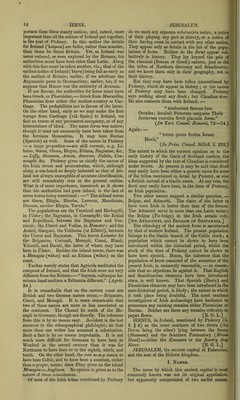
![USHS. coast of Pcntus, 130 stadia to the tiorth-east of Po- lemoniuin; it is the most projecting cape on that coast, and forms the terminating point of the chain of Mount Paryadres. It was believed to have re- ceived its name from the fact that Jason had landed there. (Strab. xii. p. 548; Arrian, Peripl. p. 17; Anonym. Peripl. p. 11; Ptol. v. 6. § 4 ; Xenoph. Anah. vi. 2. § 1, who calls it ’laaovia aicri].') It still bears the name Jasoon, though it is more com- monly called Cape Bona or Vona, from a town of the same name. (Hamilton, Researches, vol. i. p. 269.) The Asineia, called a Greek acropolis by Scylax (p. 33), is probably no other than the Jaso- nium. [L. S.] lASPIS. [CONTESTANIA.] lASSII (Tduutot), mentioned by Ptolemy as a population of Upper Pannonia (ii. 14. § 2). Pliny’s form of the name (iii. 25) is Iasi. He places them on the Drave. [R. G. L,] lASSUS, or lASUS (^lacraos, or *'la<ros ; Eih. ’latrireos), a town of Caria, situated on a small island close to the north coast of the lasian bay, which derives its name from lassus. The tovm is said to have been founded at an unknown period by Argive colonists ; but as they had sustained severe losses in a war with the native Carians, they invited the son of Neleus, who had previously founded Mi- letus, to come to their assistance. The town appears on that occasion to have received additional settlers. (Polyb. xvi. 12.) The town, which appears to have occupied the whole of the little island, had only ten stadia in circumference; but it nevertheless acquii-ed great wealth (Thucyd. viii. 28), from its fisheries and trade in fish (Strab. xiv. p. 658). After the Si- cilian expedition of the Athenians, during the Pelo- ponnesian war, lassus was attacked by the Lace- daemonians and their allies; it was governed at the time by Amorges, a Persian chief, who had revolted from Darius. It was taken by the Lacedaemonians, who captured Amorges, and delivered him up to Tissaphernes. The town itself was destroyed on that occasion; but must have been rebuilt, for we after- wards find it besieged by the last Philip of Macedonia, who, however*, was compelled by the Romans to re- store it to Ptolemy of Egypt. (Polyb. xvii. 2; Liv. xxxii. 33; comp. Ptol. v. 2. § 9; Plin. v. 29; Stad. Mar. Magn. §§ 274, 275; Hierocl. p. 689.) The mountains in the neighbourhood of lassus furnished a beautiful kind of marble, of a blood-red and livid white colour, which was used by the ancients for ornamental purposes. (Paul. Silent. Ecphr. S. Soph. ii. 213.) Near the town was a sanctuary of Hestias, with a statue of the goddess, which, though stand- ing in the open air, was believed never to be touched by the rain. (Polyb. xvi. 12.) The same story is related, by Strabo, of a temple of Artemis in the same neighbourhood. lassus, as a celebrated fish- ing place, is alluded to by Athenaeus (iii. p. 105, xiii. p. 606). The place is still existing, under the name of AsTcem or Asyn Kalessi. Chandler (^Tra- vels in As. Min. p. 226) relates that the island on which the town was built is now united to the main- lATRTTS. 5 land by a small isthmus. Part of the city walls still exist, and are of a regular, solid, and handsome structure. In the side of tne rock a theatre wdth many rows of seats still remains, and several in- scriptions and coins have been found there. (Comp. Spon and Wheler, Voyages, vol. i. p. 361.) A second town of the name of lassus existed in Cappadocia or Armenia Minor (Ptol. v. 7. § 6), on the north-east of Zoropassus. [L. S.] lASTAE (’lao-rat, Ptol. vi. 12), a Scythian tribe, whose position must be sought for in the neighbour- hood of the river lastus. [E. B. J.] lASTUS (■'lacTTos), a river which, according to Ptolemy (vi. 12), was, like the Polytimetus (^Kohik'), an affluent of the Caspian basin, and should in fact be considered as such in the sense given to a denomi- nation which at that time embraced a vast and com- plicated hydraulic system. [Jaxartes.] Von Humboldt (^Asie Centrale, vol. ii. p. 263) has iden- tified it with the Kizil-Deria, the dry bed of which may be traced on the barren wastes of Kizil Koiim in W. Turkistan. It is no unusual circumstance in the sandy steppes of N. Asia for rivers to change their course, or even entirely to disappear. Thus the Kizil-Deria, which was known to geographers till the commencement of this century, no longer exists. (Comp. Levchine, Hordes et Steppes des Kirghiz Kazaks, p. 456.) [E. B. J.] lASTUS, a river mentioned by Ptolemy (vi. 14. § 2) as falling into the Caspian between the Jaik and the Oxus. It is only safe to call it one of the numerous rivers of Independent Tartary. [R. G. L.] lASUS. [Oeum.] lA'TII Qlarioi, Ptol. vi. 12. § 4), a people in the northern part of Sogdiana. They are also mentioned by Pliny (vi. 16. s. 18); but nothing certain is known of their real position. [V. j lATINUM (^idrivov), according to Ptolemy (ii. 8. § 15) the city of the Meldi, a people of Gallia Lugdunensis. It is supposed to be the same place as the Fixtuinum of the Table [Fixtuinum], and to be represented by the town of Meaux on the Marne. Walckenaer, who trusts more to the accu- racy of the distances in the Table than we safely can do, says that the place Fixtuinum has not in the Table the usual mark which designates a capital town, and that the measures do not carry tlie posi- tion of Fixtuinum as far as Meaux, but only as far as Montbout. He conjectures that the word Fix- tuinum maybe a corruption of Fines Iatinorum,and accordingly must be a place on the boundary of the little community of the Meldi. This conjecture might be good, if the name of the people was latini, and not Meldi. [G. L.^ JATRIPPA. [Lathrippa.] lATRA or lATRUM (’larpdu), a town in Moesia, situated at the point where the river latrus or lantrus empties itself into the Danube, a few miles to the east of Ad Novas. (Procop. de Aed. iv. 7 ; Theo- phylact. vii. 2 ; Notit. Imp. 29, where it is errone- ously called Latra ; Geogr. Rav.. iv. 7, where, as in the Pent. Tab., it bears the name Laton.) [L. S.] lATRUS (in the Pent. Tab. Iantrus), a river traversing the central part of Moesia. It has its sources in Mount Haemus, and, having in its course to the north received the waters of several tributaries, falls into the Danube close by the town of latra. (Plin. iii. 29, where the common reading is leterus ; Jornand, Get.\9>-, Geogr. Rav. iv. 7.) It is probably the same as the Athrys (^A6pvs) mentioned by He- rodotus (iv. 49). Its modern name is lantra. [L-S.] COIN OF IASUS in CARIA.](https://iiif.wellcomecollection.org/image/b24872441_0002_0025.jp2/full/800%2C/0/default.jpg)