Volume 1
A dictionary of Greek and Roman geography / by various writers ; edited by William Smith.
- Date:
- 1873
Licence: Public Domain Mark
Credit: A dictionary of Greek and Roman geography / by various writers ; edited by William Smith. Source: Wellcome Collection.
32/1140 (page 10)
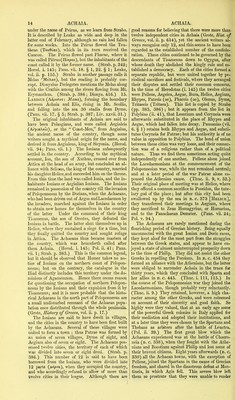
![B. c., the Corinthians founded Leucas, Anactorium, Sollium, and other towTis on the coast. (Strab. p. 452.) The original inhabitants of the country were driven more into the interior; they never made much progress in the arts of civilised life; and even at the time of the Peloponnesian war, they were a rude and barbarous people, engaged in con- tinual wars with their neighbours, and living by robbery and piracy. (Thuc. i. 5.) The Acar- nanians, however, were Greeks, and as such were allowed to contend in the great Pan-Hellenic games, although they were closely connected with their neighbours, the Agraeans and Amphilochians on the gulf of Ambracia, who were barbarian or non- Hellenic nations. Like other rude mountaineers, the Acamanians are praised for their fidelity and courage. They formed good light-armed troops, and were excellent slingers. They lived, for the most part dispersed in villages, retiring, when at- tacked, to the mountains. They were united, how- ever, in a political League, of which Aristotle wrote an account in a work now lost. (^hKapvavuv IloAi- T6ta, Strab. p. 321.) Thucydides mentions a hill, named Olpae, near the Amphilochian Argos, which the Acamanians had fortified as a place of judicial meeting for the settlement of disputes. (Thuc. iii. 105.) The meetings of the League were usually held at Stratus, which was the chief town in Acar- nania (Xen. Hell. iv. G. § 4; comp. Thuc. ii. 80); but, in the time of the Romans, the meetings took place either at Thyrium, or at Leucas, the latter of which places became, at that time, the chief city in Acarnania (Liv. xxxiii. 16, 17; Polyb. xxviii. 5.) At an early period, when part of Amphilochia be- longed to the Acamanians, they used to hold a public judicial congress at Olpae, a fortified hill about 3 miles from Argos Amphilochicum. Of the constitu- tion of their League we have scarcely any par- ticulars. We learn from an inscription found at Funta, the site of ancient Actium, that there was a Council and a general assembly of the people, by which decrees were passed. (■'ESo|e ra ySouAa koX Tcp Koivip Twv ’AKapvduuv'). At the head of the League there was a Strategus (^Tparrjyos') or General; and the Council had a Secretary (ypaju.fj,a- T€vs), who appears to have been a person of import- ance, as in the Achaean and Aetolian Leagues. The chief priest (tepaTroAos) of the temple of Apollo at Actium seems to have been a person of high rank; and either his name or that of the Stra- tegus was employed for oflBcial dates, like that of the first Archon at Athens. (Bockh, Corpus Inscript. Xo. 1793.) The history of the Acamanians begins in the time of the Peloponnesian war. Their hatred against the Corinthian settlers, who had deprived them of all their best ports, naturally led them to side with the Athenians; but the immediate cause of then: alliance with the latter ai'ose from the expulsion of the Amphilochians from the town of Argos Amphi- lochicum by the Corinthian settlers from Ambracia, about B. c. 432. The Acamanians espoused the cause of the expelled Amphilochians, and in order to obtain the restoration of the latter, they apphed for assistance to Athens. The Athenians accordingly sent an expedition under Phormio, who took Argos, expelled the Ambraciots, and restored the town to the Amphilochians and Acamanians. An alliance was now formally concluded between the Acama- nians and Athenians. The only towns of Acarnania which did not join it were Oeniadae and Astacus, The Acamanians were of great service in maintain- ing the supremacy of Athens in the western part of Greece, and they distinguished themselves particu- larly in B. c. 426, when they gained a signal victory under the command of Demosthenes over the Pelo- ponnesians and Ambraciots at Olpae. (Thuc. iii. 105, seq.) At the conclusion of this campaign they concluded a peace with the Ambraciots, although they still continued allies of Athens (Thuc. iii. 114.) In B. c. 391 we find the Acamanians engaged in war with the Achaeans, who had taken possession of Calydon in Aetolia; and as the latter were hard pressed by the Acamanians, they applied for aid to the Lacedaemonians, who sent an army into Acar- nania, commanded by Agesilaus. The latter ravaged the country, but his expedition was not attended udth any lasting consequences (Xen. Hell. iv. 6). After the time of Alexander the Great the Aetolians conquered most of the towns in the west of Acar- nania; and the Acamanians in consequence united themselves closely to the Macedonian kings, to whom they remained faithful in their various vicissitudes of fortune. They refused to desert the cause of Philip in his war with the Romans, and it was not till after the capture of Leucas, their principal town, and the defeat of Philip at Cynoscephalae that they submitted to the Romans. (Liv. xxxiii. 16—17.) When Antiochus III. king of Syria, invaded Greece, B. c. 191, the Acamanians were persuaded by their countryman Mnasilochus to espouse his cause; but on the expulsion of Antiochus from Greece, they came again under the supremacy of Rome. (Li’s, xxxvi. 11—12.) In the settlement of the affairs ol Greece by Aemilius Paulus and the Roman commis- sioners after the defeat of Perseus (b. c. 168), Leucas was separated from Acarnania, but no other change was made in the country. (Liv. xlv. 31.) When Greece was reduced to the form of a Roman province, it is doubtful whether Acarnania was an- nexed to the province of Achaia or of Epeirus, but it is mentioned at a later time as part of Epeirus. [Achaia, No. 3.] The inhabitants of several of its towns were removed by Augustus to Nicopolis, which he founded after the battle of Actium [Ni- copolis] ; and in the time of this emperor the country is described by Strabo as utterly worn out and exhausted. (Strab. p. 460.) The follo’wing is a list of the towns of Acarnania. On the Ambracian gulf, from E. to W.: Limnaea, Echinus (’Exfvos, Steph. B. «. v.; Plin. iv. 2; Ai Fasili), Heracleia (Plin. iv. 2; Vonitza), ANAC'ro- muM, Actium. On or near the west of the Ionian sea, from N. to S.: Thyp.ium, Palaerus, Alyzia, Sollium, Astacus, Oeniadae. In the interior from S. to N.: Old Oenia [ enia- dae], Coronta, Metropolis, Stratus, Rhyn- chus ('PoTX^s), near Stratus, of uncertain site (Pol. ap. Ath. iii. p. 95, d.); Phytia or Phoe- teiae, Medeon. The Roman Itineraries mention COIN OF acarnania.](https://iiif.wellcomecollection.org/image/b24872441_0001_0032.jp2/full/800%2C/0/default.jpg)