Volume 1
A dictionary of Greek and Roman geography / by various writers ; edited by William Smith.
- Date:
- 1873
Licence: Public Domain Mark
Credit: A dictionary of Greek and Roman geography / by various writers ; edited by William Smith. Source: Wellcome Collection.
33/1140 (page 11)
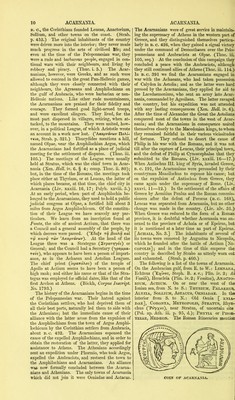
![ACCI. cnlj one road in Acamania, which led from Actium along the coast to Calydon in Aetolia. ACCI (Ak/cj; Chiodix el between Granada and Baza'), a considerable inland city of Hispania Tarraconensis, on the borders of Baetica; under the Romans a colony, with the Jus Latinum, under the full name of Colonia Julia Gemella Accitana. Its coins are numerous, bearing the heads of Augustus, Tiberius, Germanicus, Drusus, and Caligula, and the ensigns of the legions iii. and vi., from which it was colonised by Julius or Augustus, and from which it derived the name of Gemella (Itin. Ant. pp. 402, 404; Plin. iii. 3. s. 4; Inscr. ap. Gruter, p. 271; Eckhel, vol. i. pp. 34—3,5; Rasche, 5. v.) According to Macrobius (<Sa<. i. 19), Mars was wor- shipped here with his head surrounded with the sun’s rays, under the name of Netos. Such an emblem is seen on the coins. [P. S.] A'CCUA, a small toum of Apulia, mentioned only by Livy (xxiv. 20) as one of the places recovered by Q. Fabius from the Carthaginians in the fifth year of the Second Punic War, b. c. 214. It ap- pears from this passage to have been somewhere in the neighbourhood of Luceria, but its exact site is unknown. [E. H. B.] ACE (‘'Aktj: Eth.^Akouos), the Accho (‘'Akxoj) of the Old Testament (Judg. i. 31), the AlcTca of the Arabs, a celebrated town and harbour on the shores of Phoenicia, in lat. 32° 54', long. 35° 6' E. It is situated on the point of a small promontory, the northern extremity of a circular bay, of which the opposite or southern horn is formed by one of the ridges of Mount Carmel. During the period that Ptolemy Soter was in possession of Coele-Syria, it received the name of Ptolemais (JlToX^fidts; Eth. IlTo\ffidl:T7)s, IlToKe/xaievs), by which it was long distinguished. In the reign of the emperor Claudius it became a Roman colony, and was styled Colonia Claudii Caesaris Ptolemais, or simply Colonia Ptolehlais ; but from the time when it was occupied by the knights of St. John of Jerusalem, it has been generally knovra all over Christendom as St Jean cTAcre, or simply Acre. The advantages offered by the position of Acre were recognised from an early period by those who desired to keep the command of the Syrian coast, but it did not rise to eminence until after the decay of Tyre and Sidon. When Strabo wrote (p. 758), it was already a great city; and although it has under- gone many vicissitudes, it has always maintained a certain degree of importance. It originally be- longed to the Phoenicians, and, though nominally included within the territory of the tribe of Asher, was never conquered by the Israelites. It afterwards passed into the hands of the Babylonians, and from them to the Persians. According to the first dis- tribution of the dominions of Alexander it was assigned to Ptolemy Soter, but subsequently fell under the Seleucidae, and after changing hands re- peatedly eventually fell under the dominion of Rome. It is said at present to contain from 15,000 to 20,000 inhabitants. [W. R,] A'CELUM (^Asolo), a town of the interior of Venetia, situated near the foot of the Alps, about 18 miles NW. of Treviso. (Plin. iii. 19. s. 23 ; Ptol. iii, 1. § 30.) The name is written ’'AKeSov in our editions of Ptolemy, but the correctness of the form Acelum given by Pliny is confirmed by that of the modem town. We learn from Paulus Diaconus (iii. 25, where it is corruptly wTitten Acilium), that it was a bishop’s see in the 6th century. [E. H. B.] ACES. 11 ACERRAE (’Axe^/5at: Acerranus). 1. A city in the interior of Campania, about 8 miles NE. of Naples, still called Acerra. It first appears in his- tory as an independent city during the great war of the Campanians and Latins against Rome; shortly after the conclusion of which, in b.c. 332, the Acer- rani, in common with sevei-al other Campanian cities, obtained the Roman “ civitas,” but without the right of suffrage. The period at which this latter privi- lege was granted them is not mentioned, but it is certain that they ultimately obtained the full rights of Roman citizens. (Liv. viii. 17; Festus, s. v. Municipium, Municeps, and Praefectnra, pp. 127, 142, 233, ed. Muller.) In the second Punic war it was faithful to the Roman alliance, on which ac- count it was besieged by Hannibal in b. c. 216, and being abandoned by the inhabitants in despair, was plundered and burnt. But after the expulsion of Hannibal from Campania, the Acerrani, with the consent of the Roman senate, returned to and rebuilt their city, B.c. 210. (Liv. xxiii. 17, xxvii. 3.) During the Social War it was besieged oy the Samnite general, C. Papius, but offered so vigorous a resistance that he was unable to reduce it. (Ap- pian. B. C. i. 42,45.) Virgil praises the fertility of its territory, but the town itself had suffered so much from the frequent inundations of the river Clanius, on which it was situated, that it was in his time al- most deserted. (Virg. Georg, ii. 225; and Servius adloc.', Sil. Ital. viii. 537; Vib. Seq. p. 21.) It subsequently received a colony imder Augustus (Lib Colon, p. 229), and Strabo speaks of it in conjunc- tion with Nola and Nuceria, apparently as a place of some consequence. It does not seem, however, to have retained its colonial rank, but is mentioned by Pliny as an ordinary municipal town. (Strab. v. pp. 247, 249; Plin. iii. 5. s. 9; Orell. Inscr. no. 3716.) The modern town of Acerra retains the site as well as the name of the ancient one, but it does not appear that any vestiges of antiquity, except a few inscriptions, remain there. (Lupuli, Iter Verm- sin. p. 10—12.) The coins with an Oscan legend which were referred by Eckhel and earlier numisma- tists to Acei-rae, belong properly to Atella. (Mil- lingen, Numismatique de VAncierme Italie, p. 190; Friedlander, Oskischen Munzen, p. 15.) 2. A city of Cisalpine Gaul, in the territory of the Insubres. Polybius describes it merely as situ- ated between the Alps and the Po; and his W'ords are copied by Stephanus of Byzantium; but Strabo tells us that it was near Cremona; and the Tabula places it on the road from that city to Laus Pompeia {Lodi VeccMo), at a distance of 22 Roman miles from the latter place, and 13 from Cremona. These distances coincide with the position of Gherra or Gera, a ‘sillage, or rather suburb of Pizzighetione, on the right bank of the river Adda. It appears to have been a place of considerable strength and im- portance (probably as commanding the passage of the- Adda) even before the Roman conquest: and in B.c.. 222, held out for a considerable time against the* consuls Marcellus and Scipio, but was compelled to- surrender after the battle of Clastidium. (Pol. ii. 34 Plut. Marc. 6 ; Zonar. vdii. 20 ; Strab. v. p. 247 Steph. B. s. V.; Tab. Pent.; Cluver. Ital. p. 244.) 3. A third town of the name, distinguished by the epithet of Vatriae, is mentioned by Pliny (iii. 14, s. 19) as having been situated in Umbria, but it was already destroyed in his time, and all clue to its po- sition is lost. H. B.] ACES (^Ak7]s), a river of Asia, flowing through.](https://iiif.wellcomecollection.org/image/b24872441_0001_0033.jp2/full/800%2C/0/default.jpg)