Volume 1
A dictionary of Greek and Roman geography / by various writers ; edited by William Smith.
- Date:
- 1873
Licence: Public Domain Mark
Credit: A dictionary of Greek and Roman geography / by various writers ; edited by William Smith. Source: Wellcome Collection.
42/1140 (page 20)
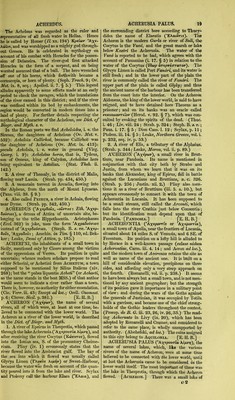
![this name near Hermione in Argolis. (Pans. ii. 35. § 10.) , , ACHEEU'SIA PALUS ('Axtpotvta Xifii/rf), the name given to a small lake or saltwater pool in Cam- pania separated from the sea only by a bar of sand, between Cumae and Cape Misenum, now called di Fmaro. The name appears to have been bestowed on it (probably by the Greeks of Cumae) in consequence of its proximity to Avernus, when the legends con- necting that lake with the entrance to the infernal regions had become established. [Aveenus.] On this account the name was by some applied to the Luciine lake, while Artemidorus maintained that the Acherusian lake and Avernus were the same. (Strab. v.pp. 243,245; Plin.iii. 5. s. 9.) Thedi Fmaro could never have had any direct connection with the volcanic phenomena of the region, nor could it have partaken of the gloomy and mysterious character of Lake Avernus. The expressions applied to it by Lycophron {Alex. 695) are mere poetical hyperbole: and Virgil, where he speaks of tenebrosa palm Acheronte ref mo (Aen. vi. 107), would seem to re- fer to Avernus itself rather than to the lake in ques- tion. In later times, its banks were adorned, in com- mon with the neighbouring shores of Baiae, mth the villas of wealthy Romans; one of these, which be- longed to Servilius Vatia, is particularly described by Seneca (Fp. 55). £E. H. B.] ACHE'TUM. [Acherini.] ACHILLA, ACHOLLA, or ACHULLA (’Ax<{A- Aa : Eth. ’AxoAAa7os, Achillitanus: El Aliah, large Ru.), a town on the sea-coast of Afiica Propria (Byzacena), a little above the N. extremity of the Lesser Syrtis, and about 20 G. miles S. of Thapsus. It was a colony from the island of Melita {Malta), the people of which were colonists from Carthage. Under the Romans, it was a free city. In the African war, B. c. 46, it submitted to Caesar, for whom it was held by Messius; and it was in vain besieged by the Pompeian commander Considius. Among its ruins, of a late style, but very extensive, there has been found an interesting bilingual in- scription, in Phoenician and Latin, in which the name is spelt Achulla (Steph. B. s. v.; Strab. p. 831; Liv. xxxiii. 48; Appian. Pun. 94; Hirtius, Bell. Afric.2tZ—43; Plin. v. 4; Ptol.; Tab. Pent., name con-upted into Anolla; Shaw’s Travels, p. 193 ; Barth, Wanderungen, 4'C. vol. i. p. 176; Gesenius, Monum. Phoenic. p. 139.) [P. S.] ACHILLE'OS DROMOS (Apo^uos or ’AxtAA€0)s, or ’AxtAAeios, or ’AxiAA.^ios), a long narrow strip of land in the Euxine, NW. of the Chersonesus Taurica {Crimea) and S. of the mouth of the Borysthenes {Dnieper), ninning W. and E., with a slight inclination N. and S., for about 80 miles, including that portion of the coast from which it is a prolongation both ways. It is now divided by a narrow gap, which insulates its W. portion, into two parts, called Kosa (i. e. tongue) Tendra on the W., and Kosa Djarilgatch on the E. In the uncient legends, which connected Achilles with the N\V. shores of the Euxine, this strip of land was pitched upon as a sort of natural stadium on which he might have exercised that smftness of foot which Homer sings; and he was supposed to have instituted games there. Further to the W., off the mouth of tjie Ister, lay a small island, also sacred to the hero, who had a temple there. This island, called Achillis In- sula, or Leuce (’AxtA\eo)s ^ AeuK?) vrjcros), was said to be the place to which d'hetis transported the body of Achilles. By some it was made the abode of the shades of the blest, where Achilles and other heroes were the judges of the dead. Geographers identify it with the little island of Zmievoi, or Oulan Adassi (i. e. Serpents' Island) in 30° 10' E long., 45° 15' N. lat. (Herod, iv. 55, 76; Eurip. Iphig. in Taur. 438; Pind. Olymp. ii. 85; Pans. hi. 19. § 11; Strab. pp. 306—308, folk; and other passages col- lected by Ukert, vol. in. p. 2,pp. 442, folk, and For- biger, vol. hi. pp. 1121—1122.) [P. S.] ACHILLE'UM (’AxtAAetov), a small town near the promontory Sigeum in the 'Troad (Herod, v. 94), where, according to tradition, the tomb of Achilles was. (Strab. p. 594.) When Alexander visited the place on his Asiatic expedition, b. c. 334, he placed chaplets on the tomb of Achilles. (An-ian, i. 12.) [G. L.] ACHILLIS INSULA. [Achilleos Dromos.] ACHOLLA. [Achilla.] ACHRADU'S. [Acherdus.] ACHRIS, or A'CHRITA. [Lychnidus.] A'CILA (’A/clAo), which seems to be identical with OCE'LIS (''O/crjAis), now Zee Hill or Chela, a seaport of the Sabaei Nomades, in Arabia Felix, a short distance to the S. of Mocha, and to the N. of the opening of the strait of Babel Mandeb. (Strab. p. 769; Phn. vi. 23. s. 26, 28. s. 32; Ptol. vi. 7. § 7.) By some geographers it is identified with the BouAjkos of the Homeritae mentioned by Procopius (X.P. i. 19). [W.R.] ACIMINCUM, ACUMINCUM CAKobpiyKov, Ptol. ii. 16. § 5 : Alt-Salankemen), a station or per- manent cavalry barrack in Pannonia. (Amm. Marc, xix. 11. §7; Notit. Imp.) By George of Ravenna (iv. 19), and on the Peutingerian Table, the name is written Acunum. [W. B. D.] ACINCUM, AQUINCUM {'Akovijkov, Ptol. ii. 16. § 4; Tab. Pent.; Orelli, Inscript. 506, 959, ! 963, 3924; Amm. Marc. xxx. 5; Itin. Anton.), a j Roman colony and a strong fortress in Pannonia, ! where the legion Adjutrix Secunda was in garrison (Dion. Cass. Iv. 24), and where also there was a , large manufactory of bucklers. Acincum, being : the centre of the operations on the Roman frontier ! against the neighbouring lazyges {Slovdcs), was occasionally the head-quarters of the emperors. It answers to the present Alt-Buda, where Roman base- ments and broken pillars of aqueducts are still visible. On the opposite bank of the Danube, and within the territory of the lazyges, stood a Roman fort (Jr outpost called, from its relative position, Contra- Acincum (Not. Imp.), which was connected with Acincum by a bridge. Contra-Acincum is named Ueacnor by Ptolemy (iii. 7. § 2). [W. B. D.] ACFNIPO {'AKiv'nrTTco: Honda la Vieja, Ru. 2 leagues N. of Honda), a town of Hispania Baetica, on a lofty mountain. Ptolemy calls it a city of the Celtici (ii. 4. § 15.) Its site is marked by the ruins of an ac^ueduct and a theatre, amidst which many coins are found inscribed with the name of the place. (Florez, Esp. Sagr. vol. ix. pp. 16—60; Eckhel, vol. i. p. 14.) [P. S.] COIN OF ACINIPO.](https://iiif.wellcomecollection.org/image/b24872441_0001_0042.jp2/full/800%2C/0/default.jpg)