Volume 1
A dictionary of Greek and Roman geography / by various writers ; edited by William Smith.
- Date:
- 1873
Licence: Public Domain Mark
Credit: A dictionary of Greek and Roman geography / by various writers ; edited by William Smith. Source: Wellcome Collection.
46/1140 (page 24)
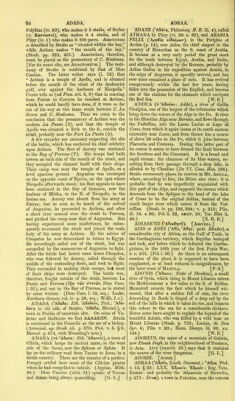
![^4 ADADA. Polybius (iv. 63), who makes it 5 stadia, of Scylax {v. Kacrawirol'), who makes it 4 stadia, and of Pliny (iv. 1) who makes it 500 paces. Anactorium IS described by Strabo as “ situated within the bay,” while Actium makes “ the mouth of the bay.” (Strab. pp. 325, 451.) Anactorium, therefore, must be placed on the promontory of C. Madonna. [For its exact site, see Anactorium.] The testi- mony of Strabo is confirmed by that of Dion Cassius. The latter writer says (1. 12) that “ Actium is a temple of Apollo, and is situated before the mouth of the strait of the Ambraciot gulf, over against the harbours of Nicopolis.” Cicero tells us (ad Fam. xvi. 6, 9) that in coasting from Patrae to Corcyra he touched at Actium, which he could hardly have done, if it were so far out of his w’ay as the inner strait between C. La Scara and C. Madonna. Thus we come to the conclusion that the promontory of Actium was the modem La Punta (3), and that the temple of Apollo was situated a little to the S., outside the strait, probably near the Fort La Punta (5). A few remarks are necessary respecting the site of the battle, which has conferred its chief celebrity upon Actium. The fleet of Antony was stationed in the Bay of Prevesa (P). His troops had built towers on each side of the mouth of the strait, and they occupied the channel itself with their ships. Their camp was near the temple of Apollo, on a level spacious gromid. Augustus was encamped on the opposite coast of Epiras, on the spot where Nicopolis afterwards stood; his fleet appears to have been stationed in the Bay of Gomaros, now the harbour of Mitika, to the N. of Nicopolis, in the Ionian sea. Antony was absent from his army at Patrae; but as soon as he heard of the arrival of Augustus, he proceeded to Actium, and after a short time crossed over the strait to Prevesa, and pitched his camp near that of Augustus. But having experienced some misfortunes, he subse- quently re-crossed the strait and joined the main body of his army at Actium. By the advice of Cleopatra he now determined to return to Egypt. He accordingly sailed out of the strait, but was compelled by the manoeuvres of Augustus to fight. After the battle had lasted some hours Cleopatra, who was followed by Antony, sailed through the middle of the contending fleets, and took to flight. They succeeded in making their escape, but most of their ships were destroyed. The battle was, therefore, fought outside of the strait, between La Punta and Prevesa (e|w ruv (TTerwu, Dion Cass. 1. 31), and not in the Bay of Prevesa, as is stated by some writers. (Dion Cass. 1. 12, seq.; Leake, Northei'n Greece., vol. iv. p. 28, seq.; Wolfe, 1. c.) A'DADA C'ASaSa: Eth. ’ASaSeus, PtoL; ’A5o- SaTTj in old edit, of Strabo; ’05d5a, Hierocl.), a town in Pisidia of uncertain site. On coins of Va- lerian and Galhenus we find AAAAEHN. Adada is mentioned in the Councils as the see of a bishop. (Artemiod. ap. Strab. xii. p. 570; Ptol. v. 5. §8; Hierocl. p. 674, with Wesseling’s note.) A'DANA (to ’'Abaua: Eth. ’ASaveos), a town of Cihcia, which keeps its ancient name, on the west side of the Sams, now the Syhoon or Sykdn. It lay on the military road from Tarsus to Issus, in a fertile country. There are the remains of a portico. Pompey settled here some of the Cilician pirates whom he had compelled to submit. (Appian, Mith. 96.) Dion Cassius (xlvii. 31) speaks of Tarsus and Adana being always quarrelling. [G. L.] ADRAA. ADANE (\\Mvrj, Philostorg. II. E. iii. 4), called ATHANA by Pliny (vi. 28. s. 32), and ARABIA FELIX (’ApaSla eudai/ji.wv'), in the^ Periplus of Arrian (p. 14), now Aden, the chief seaport in the country of Homeritae on the S. coast of Arabia. It became at a very early period the great mart for the trade between Egypt, Arabia, and India; and although destroyed by the Romans, probably by Aelius Gallus in his expedition against Arabia, in the reign of Augustus, it speedily revived, and has ever since remained a place of note. It has revived conspicuously within the last few years, having fallen into the possession of the English, and become one of the stations for the steamers which navigate the Red Sea. [W. R.] A'DDUA (o ’ASouas: Adda), a river of Gallia Cisalpina, one of the largest of the tributaries which bring doAvn the waters of the Alps to the Po. It rises in the Rhaetian Alps near Bormio, and flows through the Valtelline, into the Lacus Laiius or Lago di Como, from which it again issues at its south- eastern extremity near Lecco, and from thence has a course | of above 50 miles to the Po, which it joins between Placentia and Cremona. During this latter part of its course it seems to have formed the limit between the Insubres and the Cenomani. It is a broad and rapid stream: the clearness of its blue waters, re- sulting from their passage through a deep lake, is alluded to by Claudian (Be VI. Cons. Hon. 196). Strabo erroneously places its sources in Mx. Adula, where, according to him, the Rhine also rises: it is probable that he was imperfectly acquainted with this part of the Alps, and supposed the stream which descends from the Splugen to the head of the lake of Como to be the original Addua, instead of the much larger river which enters it from the Val- telline. (Strab. iv. pp. 192,204; v. p. 213; Plin. iii. 16. s. 20; Pol. ii. 32, xxxiv. 10; 'Y-aa. Hist. ii. 40.) [E. H. B.] ADIABE'NE (’AStogr/v^). [Assyria.] ADIS or ADES (’A5ls,‘'ABr}s: prob. Bhades),sk considerable city of Africa, on the Gulf of Tunis, in the Carthaginian territory, which Regulus besieged and took, and before which he defeated the Cartha- ginians, in the 10th year of the first Punic War, B. c. 255. (Pol. i. 30.) As there is no subsequent mention of the place, it is supposed to have been supplanted, or at least reduced to insignificance, by the later town of Maxula. [P.S.] ADONIS (^AScouts: Nahr el Ibrahim), a small river of Syria, which rising in Mount Libanus enters the Mediterranean a few miles to the S. of Byblus. Maundrell records the fact which he himself wit- nessed, that after a sudden fall of rain, the river descending in floods is tinged of a deep red by the soil of the hills in which it takes its rise, and imparts this colour to the sea for a considerable distance. Hence some have sought to explain the legend of the beautiful Adonis, who was killed by a wild boar on Mount Libanus (Strab. p. 755; Lucian, de Dea Syr. 6; Plin. v. 20.; Nonn. Dionys. iii. 80, xx. 144.) [W. R.] ADOREUS, the name of a mountain of Galatia, now Elmah Dagh, in the neighbourhood of Pessinus, in Asia. Livy (xxxviii. 18.) says that it contains the source of the river Sangarius. [G. L.] ADORSI. [Aorsi.] ADRAA (’ASpda, Euseb. Onomast.: ''Adpa^ Ptol. V. 15. §23: LXX. ’ESpaetV, ’ESpaiv : Eng. Vers. Edrei ; and probably the ’ASpacraos of Hierocles, p. 273 : Draa), a town in Palestine, near the sources](https://iiif.wellcomecollection.org/image/b24872441_0001_0046.jp2/full/800%2C/0/default.jpg)