Volume 1
A dictionary of Greek and Roman geography / by various writers ; edited by William Smith.
- Date:
- 1873
Licence: Public Domain Mark
Credit: A dictionary of Greek and Roman geography / by various writers ; edited by William Smith. Source: Wellcome Collection.
47/1140 (page 25)
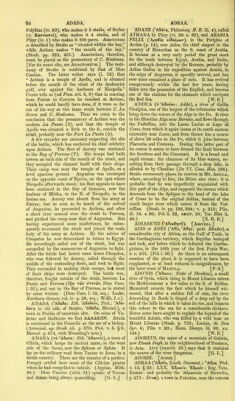
![ADRAISTAE. of the river Hieromax, and deeply embayed in the spurs of the mountain chain of Hermon. Before the conquest of Canaan by Joshua, it was one of the chief cities of Og, king of Bashan. After his defeat and death it was assigned to the half tribe of Ma- nasseh, which settled on the eastern side of Jordan. It was the seat of a Christian bishop at an early time, and a bishop of Adraa sat in the council of Seleucia (a. d. 381), and of Chalcedon (a. d. 451). By the Greeks it was called Adraa, and by the Crusaders Adratum. Its ruins cover a circuit of about 2 miles, of which the most, important is a large rectangular building, surrounded by a double covered colonnade, and with a cistern in the middle. (Numbers, xxi. 33; Beuteron. i. 4, iii. 10; Joshua xii. 4, xiii. 12, 31 ; Joseph. Antiq. iv. 5. § 42 ; Buckingham, Travels, vol. ii. p. 146 ; Burckhardt, id. p. 241.) [W. B. D.] ADRAISTAE (’ASpatorTat), a people of N. India (the Panjab), with a capital city Pimprama (ITi'iu- irpa/xa), which Alexander reached in a day’s journey from the Hydraotes (Ravee), on his march to Sangala. (Arrian. Anab. v. 22. § 3.) Lassen iden- tifies them with the modem Arattas (JPentapotamia, p. 25). [P. S.] ADRAMI'TAE or ATRAMTTAE (Plin. vi. 28. s. 32; ’Adpafurai, Ptol.; Asn-dn, Perip. p. 15). an Arabian tribe in the district Chatramotitis of Arabia Felix. They were situated on the coast of the Red Sea eastward of Aden, and their name is still preserved in the modem Hadramaut. Like their immediate neighbours in Arabia Felix, the Adramitae were actively engaged in the dmg and spice trade, of which their capital Sabbatha was the emporium. They were governed by a race of kings, who bore the family or official title of Eleazar. [Chatka- MOTITAE.] [W. B. D.] ADRAMYE'NTTUS SINUS. [Adramyttium; ADRAMY'TTIUM or ADRAMYTE'UM (A5pa- pvTTiov, ’ASpafivTTeiov, 'AtpafivTrior, 'Arpajavr- Tciov: Eth. 'Abpapvrrrfpos, Adramyttenus : Adra- miti or Edremit), a town situated at the head of the bay, called from it Adramyttenus, and on the river Caicus, in Mysia, and on the road from the Helles- pontus to Pergamum. According to tradition it was founded by Adramys, a brother of Croesus, king of Lydia; but a colony of Athenians is said to have sub- sequently settled there. (Strab. p. 606.) The place certainly became a Greek town. Thucydides (v. 1; viii. 108) also mentions a settlement here from Delos, made by the Delians whom the Athenians removed from the island b. c. 422. After the establishment of the dynasty of the kings of Per- gamum, it was a seaport of some note; and that it had some shipping, appears from a passage in the Acts of the Apostles (xxvii. 2). Under the Romans it was a Conventus Juridicus in the pro- vince of Asia, or place to which the inhabitants of the district resorted as the court town. There are no traces of ancient remains. [G. L.] ADRANA {Eder), a river of Germany in the territory of the Chatti,near Cosset. (Tac. Ann. i. 56.) ADRANS, ADRA'NA, ADRA'NTE(To’'ASpava, Zos. ii. 45; Hadrans, Itiner. Hieros. p. 560: St. Oswald on the Drauberg), a town in Noricum, situ- ated between the towns Aemona and Celeia, in the valley separating Mt. Cetius from Mt. Carvancas. A vestige of its Roman origin or occupation still survives in its local appellation of Trajaner~dorf ox Trajan’s-thorpe. (Itin. Anton.) [W. B. D.] ADRA'NUM, or HADRA'NUM (’ASpovoV, Died. ADRIA. 25 Steph. B. Hadrantjm, Sil. Ital.: Eth. 'Abpavhris^ Hadranitanus: Ademd),a. city of the interior of Sicily, situated at the foot of the western slope of Mt. Aetna above the valley of the Simeto, and about 7 miles from Centuripi. We learn from Diodorus (xiv. 37) that there existed here from very ancient times a temple of a local deity named Adranus, whose worship was extensively spread through Sicily, and appears to have been connected with that of the Palici. (Hesych. s. v. IlaAiKot.) But there was no city of the name until the year 400 b. c. when it was founded by the elder Dionysius, with a view to extend his power and in- fluence in the interior of the island. (Diod. 1. c.) It probably continued to be a dependency of Syra- cuse; but in 345 b. c. it fell into the hands of Ti- moleon. (Id. xvi. 68; Pint. Timol. 12.) It was one of the cities taken by the Romans at the com- mencement of the First Punic War (Diod. xxiii. Exc. Hoesch. p. 501), and probably on this account continued afterwards in a relation to Rome inferior to that of most other Sicilian cities. This may per- haps account for the circumstance that its name is not once mentioned by Cicero (see Zumpt ad Cic. Verr. iii. 6, p. 437); but we learn from Pliny that it was in his time included in the class of the “ sti- pendiariae civitates ” of Sicily. (JI. N. iii. 8.) Both Diodorus and Plutarch speak of it as a small town owing its importance chiefly to the sanctity of its temple; but existing remains prove that it must have been at one time a place of some consideration. These consist of portions of the ancient walls and towers, built in a massive style of large squared blocks of lava; of massive substructions, supposed to have been those of the temple of Adranus; and the ruins of a large building which appears to have belonged to Roman Thermae. Numerous sepulchres also have been discovered and excavated in the immediate neighbourhood. The modem town of Adernb re- tains the ancient site as well as name: it is a consi- derable place, with above 6000 inhabitants. (Bis- cari, Viaggio in Sicilia, pp. 57—60; Ortolani, Des. Geogr. della Sicilia, p. 13; Bull. dell. Inst. Arch. 1843, p. 129.) Stephanus Byzantinus speaks of the city as situated on a river of the same name: this was evidently no other than the northern branch of the Simeto (Sy- maethus) which is still often called the Fiume d* Adernb. [E. H. B.} COIN OF ADRANUM. A'DRIA, A'TRIA, HA'DRIA, or HA'TRIA (’Adpla or ’Arp'ia). It is impossible to establish any distinction between these forms, or to assign the one (as has been done by several authors) to one city, and another to the other. The oldest form appears to have been Hatria, which we find on coins, while Hadria is that used in all inscriptions: some MSS. of Livy have Adria, and others Atria. Pliny tells us that Atria was the more ancient form, which was afterwards changed into Adria, but the Greeks seem to have early used ’ASpm for the city](https://iiif.wellcomecollection.org/image/b24872441_0001_0047.jp2/full/800%2C/0/default.jpg)