Volume 1
A dictionary of Greek and Roman geography / by various writers ; edited by William Smith.
- Date:
- 1873
Licence: Public Domain Mark
Credit: A dictionary of Greek and Roman geography / by various writers ; edited by William Smith. Source: Wellcome Collection.
77/1140 (page 55)
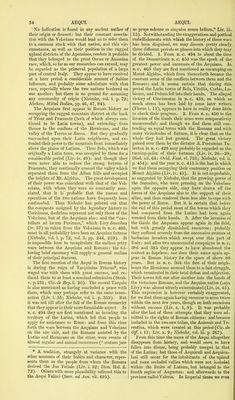
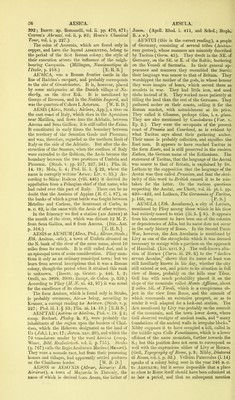
![AEQUINOCTIUM. find the Aequiculani in the valley of the Salto con- Btituting a regular municipal body, so that “ Ees Publica Aequiculanorum ” and a “ Municipium Ae- quicolanorum ” are found in inscriptions of that period (Orell. no. 3931; Ann. dell. Inst. vol. vi. p. Ill, not.). Probably this was a mere aggregation of scattered villages, and hamlets such as are still found in the district of the Cicolano. In the Liber Coloniarum (p. 255) we find mention of the “ Ecicy- lanus ager,” evidently a corruption of Aequiculanus, as is shown by the recuiTence of the same form in charters and documents of the middle ages (Holsten. not. ad Cluver. p. 156). It is not a little remarkable that the names of scarcely any cities belonging to the Aequians have been transmitted to us. Livy tells us that in the decisive campaign of b. c. 304, forty-one Aequian tovTis were taken by the Eoman consuls (ix. 45); but he mentions none of them by name, and from the ease and rapidity with which they were reduced, it is probable that they were places of little importance. Many of the smaller towns and villages now scat- tered in the hill coimtry between the vallies of the Sacco and the Anio probably occupy ancient sites: two of these, Civitella and Olevano, present remains of ancient w'alls and substructions of rude polygonal masonry, which may probably be refen-ed to a very early period (Abeken, Mittel Italien, pp. 140,147; Bullett. dell. Inst. 1841, p. 49). The numerous vestiges of ancient cities found in the valley of the Salto^ may also belong in many instances to the Aequians, rather than the Aborigines, to whom they have been generally referred. The only towns ex- pressly assigned to the Aequiculi by Pliny and Pto- lemy are Carseoli in the upper valley of the Turano, and Cliternia in that of the Salto. To these may be added Alba Fucensis, which we are expressly told by Livy was founded in the territory of the Aequians, though on account of its superior im- portance, Pliny ranks the Albenses as a separate people (Pliny iii. 12.17; Ptol.iii. 1. § 56; Liv. x. 1). Varia, which is assigned to the Aequians by several modem writers, appears to have been properly a Sabine town. Nersae, mentioned by Virgil (^Aen. vii. 744) as the chief place of the Aequiculi, is not noticed by any other writer, and its site is wholly uncertain. Besides these, Pliny (1. c.) mentions the Comini, Tadiates, Caeiici, and Alfatemi as towns or communities of the Aequiculi, which had ceased to exist in his time; all four names are othei-wise wholly unknown. [E. H. B.] AEQUINOC'TITJM or AEQUINOC'TIAE {Fis- chament), a Eoman fort in Upper Pannonia, situ- ated upon the Danube, and according to the Notitia Imperii, the quarters of a squadron of Dalmatian cavalry. (Tab. Pent.; Itin. Antonin.) [W.B.D.] AEEOPUS, a mountain in Greek Illyria, on the river Aous, and opposite to Mount Asnaus. Aeropus probably corresponds to Trehusin, and Asnaus to NemertziJea. (Liv. xxxii. 5 ; Leake, Northern Greece, vol. i. p. 389.) AESE'PUS (6 AfuTjTTos), a river of Northern Mysia, mentioned by Homer (/?. ii. 825, &c.) as flowing past Zeleia, at the foot of Ida; and in another passage (/?. xii. 21) as one of the streams that flow from Ida. According to Strabo’s interpretation of Homer, the Aesepus was the eastern boundary of Mysia. The Aesepus is the largest river of Mysia. According to Strabo, it rises in Mount Cotylus, one of the summits of Ida (p. 602), and the distance between its source and its outlet is near 500 stadia. AESEENIA. 5.5 It is joined on the left bank by the Caresus. another stream which flows from Cotylus; and then taking a NE. and N. course, it enters the Propontis, be- tween the mouth of the Granicus and the city of Cyzicus. The modem name appears not to be clearly ascertained Leake calls it BoTdu. [G. L.] AESE'ENIA (^Aicrepvia: Eth. Aeseminus; but Pliny and later writers have Eseminus),a cityof Sam- nium, included within the teiiitory of the Pentrian tribe, situated in the valley of the Vultumus, on a small stream flowing into that river, and distant 14 miles from Venafmm. The Itinerary (in which the name is corruptly written Serni) places it on the road from Aufidena to Bovianum, at the distance of 28 M.P. from the former, and 18 from the latter; but the former number is corrupt, as are the distarrees in the Tabula. (Itin. Ant. p. 102; Tab. Pent.; Plin. iii. 12. 17; Ptol. iii. 1. § 67; Sil. Ital. viii. 568.) The modern city of Isernia retains the ancient site as well as name. The first mention of it in history occurs in b. c. 295, at which time it had already fallen into the hands of the Eomans, together with the whole valley of the Virltmirus. (Liv. x. 31.) After the complete subjugation of the Samnites, a colony, with Latin rights (colonia Latina) was settled there by the Eomans in b. c. 264; and this is again mentioned in b. c. 209 as one of the eighteen which remained faithful to Eome at the most trying period of the Second Punic War. (Liv. Epit. xvi. xxvii. 10; Veil. Pat. i. 14.) During the Social War it adhered to the Eoman cause, and was gallantly de- fended against the Samnite general Vettius Cato, by Marcellus, nor was it till after a long protracted siege that it was compelled by famine to surrender, b. c. 90. Henceforth it continued in the hands of the confederates ; and at a later period of the contest afforded a shelter to the Samnite leader, Papius Mu- tilus, after his defeat by Sulla. It even became for a time, after the successive faU of Corfinium and Bovianum, the head quarters of the Italian allies. (Liv. Epit. Ixxii, Ixxiii.; Appian. B. C. i. 41, 51; Diod. xxxvii. Exc. Phot. p. 539; Sisenna ap. Nonium, p. 70.) At this time it was evidently a place of importance and a strong fortress, but it was so se- verely punished for its defection by Sulla after the final defeat of the Samnites, that Strabo speaks of it as in his time utterly deserted. (Strab. v. p. 238, 250.) We learn, however, that a colony was sent there by Caesar, and again by Augustus; but appa- rently with little success, on which account it was re- colonized under Nero. It never, however, enjoyed the rank of a colony, but appears from inscriptions to have been a municipal town of some importance in the tune of Trajan and the Antonines. To this period belong the remains of an aqueduct and a fine Eoman bridge, stiU visible; while the lower parts of the modern walls present considerable portions of polygonal construction, which may be assigned either to the ancient Samnite city, or to the first Eoman colony. The modem city is still the see of a bishop, and contains about 7000 inhabitants. (Lib. Colon, pp. 233, 260; Zumpt, de Coloniis, pp. 307, 360, COIN OF AESERNIA.](https://iiif.wellcomecollection.org/image/b24872441_0001_0077.jp2/full/800%2C/0/default.jpg)