Volume 1
A dictionary of Greek and Roman geography / by various writers ; edited by William Smith.
- Date:
- 1873
Licence: Public Domain Mark
Credit: A dictionary of Greek and Roman geography / by various writers ; edited by William Smith. Source: Wellcome Collection.
89/1140 (page 67)
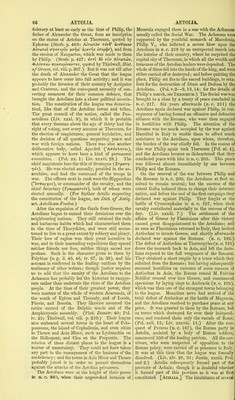
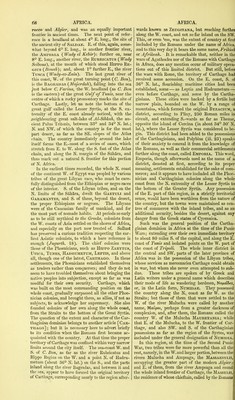
![AEXONE. of its towns were removed by Augustas to people the city of Nicopolis, which he founded to commemorate liis victory at Actium, b. c. 31; and in his time the country is described by Strabo as utterly worn out and exhausted. (Strab. p. 460.) Under the Eo- mans the Aetolians appear to have remained in the same rude condition in which they had always been. The interior of Aetolia was probably rarely visited by the Romans, for they had no road in the inland part of the country; and their only road was one lea^ng from the coast of Acarnania across the Achelous, by Pleuron and Calydon to Chalcis and Molycreia on the Aetolian coast. (Comp. Brandstaten, Die Geschichten des AetoUschen Landes, Vdikes und Btmdes, Berlin, 1844.) The towns in Aetolia were: I. In Old Aetolia. 1. In the lower plain, between the sea and Mount Aracynthus, Calydon, Pleuron, Olenus, Py- LENE, Chalcis (these 5 are the Aetolian towns mentioned by Homer), Halicyrna, Elaeus, Pae- ANiuM or Phana, Proschium, Ithoria, Conors (afterwards Arsinoe), Lysimachia. In the upper plain N. of Mount Aracynthus, Acrae, Metapa, Pamphia,Phyteum, Trichonium, Thestienses, Thermum. In Aetolia Epictetus, on the sea-coast, Macynia, Molycreium or Molycreia : a little in the interior, on the borders of Locris, Potidania, Crocyleium, Teichium, Aegitium: fui-ther in the interior, Callium, Oechalia [see p.65,a.], Ape- rantia, Agrinium, Ephyra, the last of which was a town of the Agraei. [Agraei.] The site of the following towns is quite unknown: — Ellopium (’E\Aomov, Pol. ap. Steph. B. s. v.); Thorax (0c6- pa|, s. V,); Pherae (4»epai, Steph. B. s.v.'). COIN OF AETOLIA. AEXO'NE. [Attica.] AFFILAE (^Eih. AiElanus), a town of Latium, in the more extended sense of the term, but which must probably have in earlier times belonged to the Her- nicans. It is still called Affile, and is situated in the mountainous district S. of the valley of the Anio, about 7 miles from Suhiaco. We learn from the treatise ascribed to Frontinus (de Colon, p. 230), that its territory was colonized in the time of the Gracchi, but it never enjoyed the rank of a colony, and Phny mentions it only among the “ oppida ” of Latium. (JI. N. iii. 5. § 9.) Inscriptions, fragments of columns, and other ancient relics are still visible in the modem village of Affile. (Nibby, Dintomi di Roma, vol. i. p. 41.) [E. H. B.] AFFLIA'NUS or AEFLIA'NUS MONS (the latter form of the name appears to be the more correct) was the name given in ancient times to a mountain near Tibur, fronting the plain of the Campagna and now called Monte S. Angelo, though marked on Gell’s map as Monte Affiiano. The Claudian aqueduct was carried at its foot, where the remains of it still visible are remarkable for the boldness and grandeur of their constraction. An inscription which records the completion of some of these works has preserved to us the ancient name of AFRICA. 67 the mountain. (Nibby, Dintorni di Roma, vol. i. p. 25; Fabretti, Inscr. p. 637.) [E. H. B.] A'FRICA (^A<l)piK'ft: Adj. Afer, Africus, Africa- nus), the name by which the quarter of the world still called Africa was known to the Romans, who re- ceived it from the Carthaginians, and appHed it first to that part of A frica with which they became first acquainted, namely, the part about Carthage, and afterwards to the whole contuient. In the latter sense the Greeks used the name Libya (’A</>pt/n7 only occurring as the Greek form of the Latin Africa); and the same name is continually used by Roman writers. In this work the continent is treated of under Libya; and the present article is confined to that portion of N. Africa which the Romans called specifically Africa, or Africa Propria (or Vera), or Africa Provincia (jAcppiKg g iliicos), and which may be roughly described as the old Carthaginian terri ■ tory, constituted a Roman province after the Third Punic War (b. c. 146). The N. coast of Africa, after trending W. and E. with a slight rise to the N., from the Straits of Gibraltar to near the centre of the Mediterranean, suddenly falls off to the S. at C. Bon (Mercurii Pr.) in 37° 4' 20 N. lat., and 10° 53' 35 E. long., and preserves this general direction for about 3° of lati- tude, to the bottom of the Gulf of Khabs, the an- cient Lesser Syrtis; the three chief salient points of this E. part of the coast, namely, the promontories of Clypea (at the N., a httle S. of C. Bon) and Caput Vada (^KapoudiaJi, about the middle), and the island of Meninx (Jerbah, at the S.), lying on the same meridian. The country witldn this angle, formed of the last low ridges by which the Atlas sinks down to the sea, bounded on the S. and SW. by the Great Desert, and on the W. extending about as far as 9° E. long., formed, roughly speak- ing, the Africa of the Romans; but the precise limits of the country included under the name at different periods can only be understood by a brief historical account. That part of the continent of Africa, which forms the S. shore of the Mediterranean, W. of the Delta of the Nile, consists of a strip of habitable land, hemmed in between the sea on the N. and the Great Desert (Sahara) on the S., varying greatly in breadth in its E. and W. halves. The W. part of this sea-board has the great chain of Atlas inter- posed as a barrier against the torrid sands of the Sahara; and the N. slope of this range, descending in a series of natural terraces to the sea, watered by many streams, and lying on the S. margin of the N. temperate zone, forms one of the finest regions on the surface of the earth. But, at the great bend in the coast above described (namely, about C. Bon), the chain of the Atlas ceases; and, from the shoren of the Lesser Syrtis, the desert comes close to the sea, leaving only narrow slips of habitable land, till, at the bottom of another great bend to the S., form- ing the Greater Syrtis {Gulf of Sidra), the sand and water meet (about 19° E. long.), forming a natural division between the 2 parts of N. Africa. E. of this point lay Cyrenaica, the history of which is totally distinct from that of the W. portion, with which we are now concerned. For what follows, certain land-marks must be borne in mind. Following the coast E. of the Fretum Gaditanum {Straits of Gibraltar) to near 2° W. long., we reach the largest river of N. Africa, the Malva, Mulucha, or Molochath ( Wady Mulwia or Mohalou), which now forms the boundary of Ma-](https://iiif.wellcomecollection.org/image/b24872441_0001_0089.jp2/full/800%2C/0/default.jpg)