The practice of surgery : a treatise on surgery for the use of practitioners and students / by Henry R. Wharton ... and B. Farquhar Curtis.
- Wharton, Henry R. (Henry Redwood), 1853-1925
- Date:
- 1902
Licence: Public Domain Mark
Credit: The practice of surgery : a treatise on surgery for the use of practitioners and students / by Henry R. Wharton ... and B. Farquhar Curtis. Source: Wellcome Collection.
Provider: This material has been provided by the Augustus C. Long Health Sciences Library at Columbia University and Columbia University Libraries/Information Services, through the Medical Heritage Library. The original may be consulted at the the Augustus C. Long Health Sciences Library at Columbia University and Columbia University.
27/1268 (page 13)
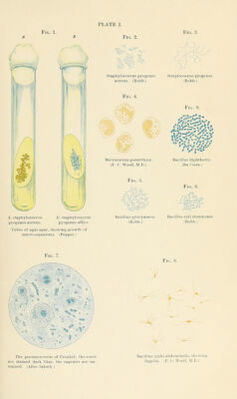
![curring in chains, from J to 1 micromillimetre in diameter, especially common in the exposed mucous cavities of the body, such as the urethra, vagina, and mouth. It grows in the usual culture media, slowly at ordinary tem- peratures, most freely at about the body temperature. In gelatin it forms small circular (rarely oval) colonies, which are at first yellow and later turn brown. The gelatin is not liquefied, and the colonies project above the sur- face, especially at their centres and on the edges. When growing in bouillon it usually settles to the bottom of the fluid as a cloudy sediment. The strep- tococcus peptonizes albumin. It produces arthrospores, grows best with free oxygen present, and can be stained by all the aniline dyes, including Gram's method. Experiments on animals appear to indicate that the streptococcus is less virulent than the S. p. aureus, but clinically it is found to excite a more dangerous form of supi^uration, with much sloughing and a tendency to spread without limitation. It. also causes erysipelas, for Pehleisen's streptococcus of erysipelas is probably identical with the ordinary strepto- coccus pyogenes, in spite of Eosenbach's efforts to distinguish them, although it may be a peculiarly modified form of that germ. The staphylococci are never found in erysipelas. The streptococcus occasionally causes osteomye- litis, but much more rarely than the staphylococcus. Micrococcus gonorrhcEse (or gonococcus) (Neisser) (Plate I., Pig. 4) will be described with the disease which it produces. Bacillus pyocyaneus (Gessard) (Plate I., Pig. 5) is a rather common pyogenic germ, which occurs in the skin and perspiration as a motile body. It grows in cultures at ordinary temperatures, and has the power of liquefy- ing the gelatin, producing a bluish-green color in free oxygen. It is found in pus, to which it gives a blue or green color, sometimes quite vivid. Bacillus coli communis (Emmerich) (Plate I., Pig. 6) is an important bacterium found in the intestinal contents, in peritoneal exudates, in the urine with cystitis, and occasionally in abscesses. It is a short rod, 1 to 3 micromillimetres long and 0.4 to 0.6 micromillimetre thick, sometimes oval in shape and resembling a micrococcus, motile (having flagella), and occurring in pairs or chains. It stains with the ordinary dyes, but is de- colorized by Gram's method. It is easily cultivated, and forms a thin film or a projecting mass on the surface of the medium, of lobulated shape, yellow color, and granulated appearance. It grows either with or withput free oxygen. The cultures are acid, do not liquefy gelatin, but decompose sugar, ]5roducing carbonic dioxide and hydrogen gas. No spores have been seen. It can be inoculated in animals, causing the same local suppurations or general infections as in man, but is very variable in its virulence. Pneumococcus or micrococcus lanceolatus (Prankel) (Plate I., Pig. 7) and B. typhi abdominalis (Plate I., Pig. 8) are also capable of causing suppurative inflammation in the cellular tissues and elsewhere, but do not need description here. Bacillus diphtheriae (Klebs, Loeffler) (Plate I., Pig. 9) has a certain amount of surgical importance, as it has in rare instances been observed in wounds, but so seldom that it merely requires mention. The bacteria of malignant oedema, anthrax, etc., will be described with the diseases which they produce.](https://iiif.wellcomecollection.org/image/b21204287_0027.jp2/full/800%2C/0/default.jpg)