The practice of surgery : a treatise on surgery for the use of practitioners and students / by Henry R. Wharton ... and B. Farquhar Curtis.
- Wharton, Henry R. (Henry Redwood), 1853-1925
- Date:
- 1902
Licence: Public Domain Mark
Credit: The practice of surgery : a treatise on surgery for the use of practitioners and students / by Henry R. Wharton ... and B. Farquhar Curtis. Source: Wellcome Collection.
Provider: This material has been provided by the Augustus C. Long Health Sciences Library at Columbia University and Columbia University Libraries/Information Services, through the Medical Heritage Library. The original may be consulted at the the Augustus C. Long Health Sciences Library at Columbia University and Columbia University.
49/1268 page 35
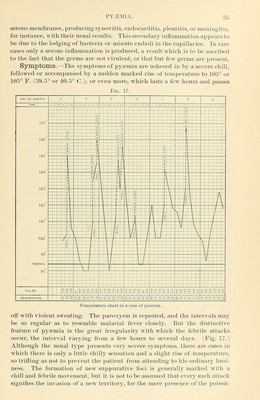
![serous membranes, producing synovitis, endocarditis, iileuritis, or meningitis, for instance, with their usual results. This secondary inflammation appears to be due to the lodging of bacteria or minute emboli in the capillaries. In rare cases only a serous inflammation is produced, a result which is to be ascribed to the fact that the germs are not virulent, or that but few germs are present. Symptoms.—The symptoms of pyaemia are ushered in by a severe chill, followed or accompanied by a sudden marked rise of temperature to 103° or 105° F. (39.5° or 40.5° C), or even more, which lasts a few hom-s and passes Fig. 17. DAV OF MONTH 3 4 5 1 6 7 s 9 1 TIME 3 1M ^ a 12 -t 3 Vi u IJ 1 u 4 |12 4 8 12 4 B 12 ■I e 12 4 a IL 4 a 12 0 1-.' tj 4 Jl IP 107° 106° 105° 104° 103° 102° 101° 100° 99° 98° 1^ - s . z z tr ^ 1 - f z - - - - x — ~ -- -^- j .- ' - - - -i -- j - 'x 1 -|- - -1 i <-. 1 ' 1 7 I'l CC f^ ' =H=i=-i - -11. T 1 ^ \ !' ^1 =c=:=^ = :' t\ il - _ J — ) - _L; 1 .. _. 1 1 - - - - - 1 1 || -1 M ■ i J ^^ '1 , - - - -r --- - ^ - - - ~ - - \ jx \ 1 - - 1 ?^ 1 7~ l\ u lJ \ 1 1! ] 1 1 I / 1 ^ aH ~ -h-!tr - 1 ._. f ~ - - j- P 1 1 ; '''']' ' r [ (Oi \ 1 \ 1 H L / - ;, 1 1 w h- \l^ -v-i— V \ 1 \ j (_ i / \h\ / ' \ \, 1 . . ' / f 1 1 - y _ - / / ', -:—;—:-'- ■ \ —-— 1 / - \ j -j- - - \-l j 1 V i r 1 LJ^; [ 1 i \ h i 1 1/ 1 - 1 1 ( PULSE 2 § 2 g i 1 i g s 5 S 1 2 I 2 = 1 s £ s s s ^ 2 s s 1 2 ° H S i 1 1 i § 2 1 RESPIRATION a s S S s a s s % ^ s s!g|K S! 3 S K S s s s s S g Sj s g s g S g 2 2 s s s ?3 Temperature chart In a case of pyaemia. off with violent sweating. The paroxysm is repeated, and the intervals may be so regular as to resemble malarial fever closely. But the distinctive feature of pysemia is the great irregularity with which the febrile attacks occur, the interval varying from a few hours to several days. (Fig. 17.) Although the usual type presents very severe symptoms, there are cases in which there is only a little chilly sensation and a slight rise of temperature, so trifling as not to prevent the patient from attending to his ordinary busi- ness. The formation of new sui^purative foci is generally marked with a chill and febrile movement, but it is not to be assumed that every such attack signiiies the invasion of a new teriitorj'', for the mere presence of the poison-](https://iiif.wellcomecollection.org/image/b21204287_0049.jp2/full/800%2C/0/default.jpg)
 No text description is available for this image
 No text description is available for this image
 No text description is available for this image