A treatise on dynamics. Containing a considerable collection of mechanical problems / By William Whewell.
- William Whewell
- Date:
- 1823
Licence: Public Domain Mark
Credit: A treatise on dynamics. Containing a considerable collection of mechanical problems / By William Whewell. Source: Wellcome Collection.
435/444 (page 399)
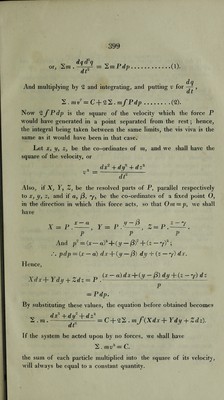
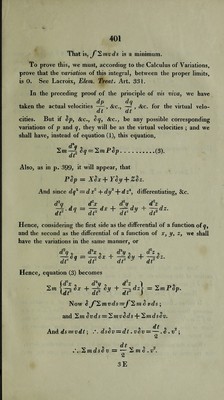
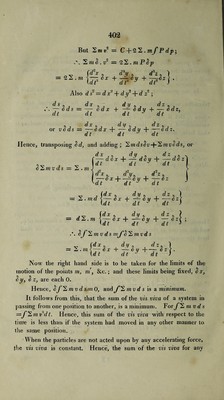
![or, S/w . dq(fq dt2 2 m P (l]> (1). And multiplying by 2 and integrating. and putting , dq v for — dt 2 . mv' = C + 2 2. mf Pdp.(2). Now 2 fP dp is the square of the velocity which the force P would have generated in a point separated from the rest; hence, the integral being taken between the same limits, the vis viva is the same as it would have been in that case. Let x, y, z, be the co-ordinates of in, and we shall have the square of the velocity, or dx2 + dy1 + dz2 dt~ Also, if X, Y, Z, be the resolved parts of P, parallel respectively to x, y, z, and if a, fi, y, be the co-ordinates of a fixed point O, in the direction in which this force acts, so that Om=p, we shall have * = r=e.-^A, z=p.^l P P V And p'J = (x — a)* + (y — /3f + (z — y)2 ; pdp = (x — a) dx + (y — /3) dy + (2 — y) d r. Hence, X d x + Y d y + Z d z — P . (x — a) dx-\-(y — /3) dy + (z —y)dz P = Pdp. By substituting these values, the equation before obtained becomes 2 . m .-^dt~ = ^ + 22 . m f^Xdx-Y Ydy + Zdz). If the system be acted upon by no forces, we shall have 2 . mv2 = C. the sum of each particle multiplied into the square of its velocity, will always be equal to a constant quantity.](https://iiif.wellcomecollection.org/image/b29297230_0435.jp2/full/800%2C/0/default.jpg)