A treatise on dynamics. Containing a considerable collection of mechanical problems / By William Whewell.
- William Whewell
- Date:
- 1823
Licence: Public Domain Mark
Credit: A treatise on dynamics. Containing a considerable collection of mechanical problems / By William Whewell. Source: Wellcome Collection.
88/444 (page 52)
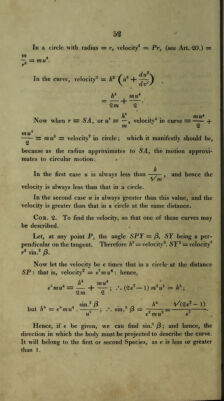
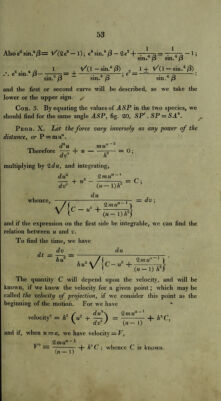
![In a circle with radius = r, velocity2 = Pr, (see Art. 20.) = m . —. = mu r4 In the curve, velocity2 = A2 h4 mu4 —-]- 2m 2 Now when r — SA, or u* = —, velocity* in curve = —— + m 2 4 7JZ U —— mu4 = velocity2 in circle; which it manifestly should be, because as the radius approximates to SA, the motion approxi¬ mates to circular motion. In the first case u is always less than , and hence the velocity is always less than that in a circle. In the second case u is always greater than this value, and the velocity is greater than that in a circle at the same distance. Cor. 2. To find the velocity, so that one of these curves may be described. Let, at any point P, the angle SPY = /3, «SF being a per¬ pendicular on the tangent. Therefore h2 = velocity*. SF2 = velocity2 r2 sin.2 /3. Now let the velocity be e times that in a circle at the distance SP : that is, velocity2 = e°mu4 : hence, JA jfYi yA f €~mu4 — —-1-; (2e2—l)m2M1 = A'i; 2m 2 4 sin.2 /3 i u .-^—: Hence, if e be given, we can find sill.2 /3; and hence, the direction in which the body must be projected to describe the curve. It will belong to the first or second Species, as e is less or greater than 1.](https://iiif.wellcomecollection.org/image/b29297230_0088.jp2/full/800%2C/0/default.jpg)