Annual report for the year 1914 : (17th year of issue) / Metropolitan Asylums Board.
- Metropolitan Asylums Board (London, England)
- Date:
- 1915
Licence: In copyright
Credit: Annual report for the year 1914 : (17th year of issue) / Metropolitan Asylums Board. Source: Wellcome Collection.
50/368 page 16
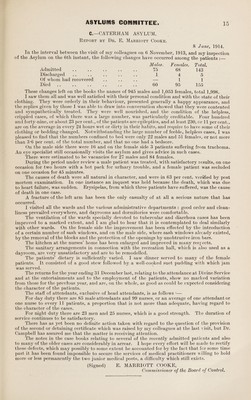
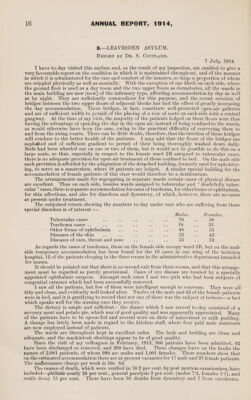
![D.—LEAVESDEN ASYLUM. Report by Dr. S. Coupland. 7 July, 1914. I have to-day visited this asylum and, as the result of my inspection, am enabled to give a very favourable report on the condition in which it is maintained throughout, and of the manner in which it is administered for the care and comfort of the inmates, so large a proportion of whom are crippled physically as well as mentally. With the exception of one block on each side, where the ground floor is used as a day room and the two upper floors as dormitories, all the wards in the main building are new [now] of the infirmary type, affording accommodation by day as well as by night. They are sufficiently commodious for this purpose, and the recent erection of bridges between the two upper floors of adjacent blocks has had the effect of greatly increasing the day accommodation. These bridges, in fact, constitute well-protected open-air galleries and are of sufficient width to permit of the placing of a row of seats on each side with a central gangway. At the time of my visit, the majority of the patients lodged on these floors were thus having the advantage of spending the day in the open air, instead of being confined to the wards, as would otherwise have been the case, owing to the practical difficulty of conveying them to and from the airing courts. There can be little doubt, therefore, that the erection of these bridges will conduce to the better health of the patients. I may add that the floors of the bridges are asphalted and of sufficient gradient to permit of their being thoroughly washed down daily. Beds had been wheeled out on one or two of them, but it would not be possible to do this on a large scale, so that, especially in respect to the female ward 2B assigned to tubercular cases, there is no adequate provision for open-air treatment of those confined to bed. On the male side such provision is afforded by the adaptation of the detached building, formerly used for upholster¬ ing, to serve as a sanatorium, where 18 patients are lodged. A similar special building for the accommodation of female patients of this class would therefore be a desideratum. The arrangements made for segregating in separate wards certain cases of physical disease are excellent. Thus on each side, besides wards assigned to tubercular and “ doubtfully tuber¬ cular” cases, there is separate accommodation for cases of trachoma, for other forms of ophthalmia, for skin affections, and also for diarrhoea and dysentery, of which, however, there are no cases at present under treatment. The subjoined return showing the numbers to-day under care who are suffering from these special disorders is of interest :— Tubercular cases Trachoma cases .. Other forms of ophthalmia Diseases of the skin Diseases of ears, throat and nose Males. Females. 70 50 18 31 48 55 52 42 33 33 As regards the cases of trachoma, those on the female side occupy ward 3B, but on the male side temporary accommodation has been found for the 18 cases in one wing of the isolation hospital, 12 of the patients sleeping in the three rooms in the administrative department intended for nurses. It should be pointed out that there is no second exit from these rooms, and that this arrange¬ ment must be regarded as purely provisional. Cases of eye disease are treated by a specially appointed ophthalmic surgeon. Amongst such cases I saw two girls who had been subjects of congenital cataract which had been successfully removed. I saw all the patients, but few of them were intelligent enough to converse. They were all tidy and clean, and evidently well looked after. Twelve of the male and 43 of the female patients were in bed, and it is gratifjdng to record that not one of these was the subject of bedsore—a fact which speaks well for the nursing care they receive. The dietary is ample and sufficient: the dinner which I saw served to-day consisted of a savoury meat and potato pie, which was of good quality and was apparently appreciated. Many of the patients have to be spoon-fed and several were on diets of mincemeat or milk pudding. A change has lately been made in regard to the kitchen staff, where four paid male assistants are now employed instead of patients. The wards are throughout kept in excellent order. The beds and bedding are clean and adequate, and the mackintosh sheetings appear to be of good quality. Since the visit of my colleagues in February, 1913, 386 patients have been admitted, 92 have been discharged or removed, and 269 have died. These changes leave on the books the names of 2,081 patients, of whom 990 are males and 1,091 females. These numbers show that on the estimated accommodation there are at present vacancies for 17 male and 97 female patients. The mafntenance charge per week is 10s. 6d. The causes of death, which were verified in 76'2 per cent, by post mortem examination, have included—phthisis nearly 24 per cent., general paralysis 3 per cent, (males 7‘3, females IT), and senile decay 15 per cent. There have been 10 deaths from dysentery and 7 from carcinoma.](https://iiif.wellcomecollection.org/image/b30300411_0050.jp2/full/800%2C/0/default.jpg)