Kalm's account of his visit to England : on his way to America in 1748 / translated by Joseph Lucas ; with two maps and several illustrations.
- Pehr Kalm
- Date:
- 1892
Licence: Public Domain Mark
Credit: Kalm's account of his visit to England : on his way to America in 1748 / translated by Joseph Lucas ; with two maps and several illustrations. Source: Wellcome Collection.
196/520 page 170
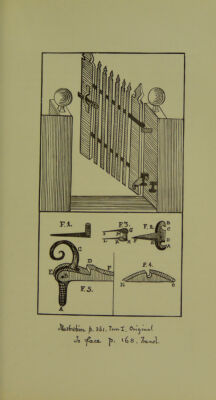
![upwards, “just” on the side of the gate-post which looks tovvards the gate. The “ driving-hook,” Fig. i, is rather long, and the gate heavy, so that when it is opened and shut again it comes to rest by its own gravity or weight, just so that the latch falls again into the notch in the hapse for it, Fig 4. The hapse ought to be fastened on to the gate- post, so that N O, Fig. 4, is horizontal. The latch is not made to reach farther than the latitudo transver salis, or breadth at top of the hapse, so that it may be able to pass backwards and forwards and not strike against the gate-post. Another kind of klinka, “ gate-latch,” is shown in Fig. 5. Aker-grindarna, the gates of arable fields are for the most part exactly like our gates, and swing on similar hinges and gate-hooks. E F is an iron spike, et järn, driven horizontally into the side of the gate. A C is another iron, which hangs perpendicularly, but [T. I. p. 363] rides on an iron-pin, järn-nagel, at B, so that its under side E A can be bent in towards the latch-post of the gate, but not outwards from the gate farther than the perpendicular position. When the gate is open, and it is afterwards shut, the hapse, klinkan, Fig. 4 which is fixed to the gate post so that its notch faces the gate, strikes against the latch-tongue C A, Fig. 5, between E and A, when it bends its lower end A in towards the gate, and as soon as the notch in the hapse is reached, ocli sä snart Klinkan gått längrG in, it falls by its own weight back into the perpendicular position, and the gate cannot be opened again, before one bends either A inwards or C outwards so far that A C becomes nearly parallel with E F, Fig. 5. At D is a projection, en hake, as far as which this iron spike E F is driven in to the side of the latch-post of the gate, because otherwise the pin at B might be damaged while](https://iiif.wellcomecollection.org/image/b24857026_0196.jp2/full/800%2C/0/default.jpg)