The people's insurance / explained by the chancellor of the Exchequer, the Right Hon. David Lloyd George.
- David Lloyd George
- Date:
- 1912
Licence: In copyright
Credit: The people's insurance / explained by the chancellor of the Exchequer, the Right Hon. David Lloyd George. Source: Wellcome Collection.
Provider: This material has been provided by The University of Glasgow Library. The original may be consulted at The University of Glasgow Library.
189/248 (page 179)
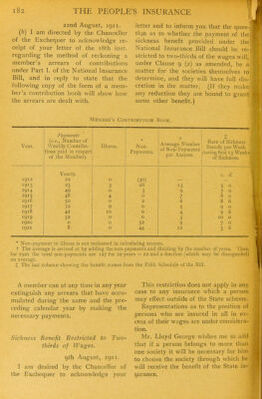
![exchequer to inform you that in his pinion it is perfectly correct to say hat the National Insurance Bill is iving the working man grf. for ^d. I'he only qualifications which require o be made in this statement afe : (i) hat though the persons insured on an 'verage all get just gd. for 4^., the )lder get somewhat more and the /ounger somewhat less; and (2) that ;ome time must elapse before the whole gd. is received. But it should be clearly understood that gd., with in- terest in addition, will ultimately be received by the insured classes for every 4^. paid in. ist September, 1911. (6) I fear it is not possible to give a very succinct answer to your inquiry as to the period that must elapse before an insured person gets gd. for 4^. You are no doubt aware that at the commencement of the scheme persons of all ages are to pay the same con- tributions and, except for persons under 21 who are unmarried and have no de- pendants and for persons over 50,* to receive the same benefits. It follows that the old will be more favourably treated than the young, and in order to mitigate this effect Mr. Lloyd George decided not to give from the com- mencement the full scale of benefits which will ultimately be possible, but to set apart a portion of the contribu- tions to accumulate for a period at the completion of which a fund will have been created equal to the reserve values of the persons insured. In the interval (which the actuaries calculated to be about 15I years under the Bill as introduced) t the persons insured will be enjoying benefits equivalent to those * The Bill as .amended also provides sickness benefit on a lower scale for insured married women, t i8i years under the Bill as amended. S INSURANCE 179 which could be purchased by a contri- bution of 7d. starting from age 16. Under this arrangement persons at ages above 16 receive benefits which are worth more than a contribution of ^d., and at the higher ages they are worth more than a contribution of gd. But even the youth of 16 is entitled to an insurance worth more than a contribution of 7^., since he has the prospect of increased benefits from the age of about 32 [under Bill as amended 34] onwards, when the period of 15^ [iSJ] years has expired. You inquire how much the older and younger contributors respectively re- ceive. I fear a precise answer is im- possible. Indeed, insurance is essentially a provision against risks, and the per- son who gets most out of it is he who suffers most from the evils against which he is insured. Some of the young, in fact, will get more in pounds, shillings, and pence per annum than some of the old, and the calculation of the true actuarial value of the insurance offered to contributors of each age from 16 to 65 would be a very lengthy and laborious undertaking. Again, as to what period of time must elapse before the whole gd. is re- ceived, I can do no better than point out that for some of the older contri- butors the insurance secured as from the beginning of the Act will be worth more than gd., but that it will not be the case that everyone entering the scheme receives insurance worth gd. until the preliminary period of accu- mulation is completed. From the he- ginning, however, it is true that the average value of the insurance given is gd. Small Societies. 15th August, igii. I am desired by the Chancellor of the Exchequer to acknowledge the receipt](https://iiif.wellcomecollection.org/image/b21465381_0189.jp2/full/800%2C/0/default.jpg)