Contributions to the morphology, synonymy, and geographical distribution of arctic plants / by Theo. Holm.
- Holm, Theodor (Herman Theodor), 1854-1932.
- Date:
- 1922
Licence: In copyright
Credit: Contributions to the morphology, synonymy, and geographical distribution of arctic plants / by Theo. Holm. Source: Wellcome Collection.
21/144 (page 19)
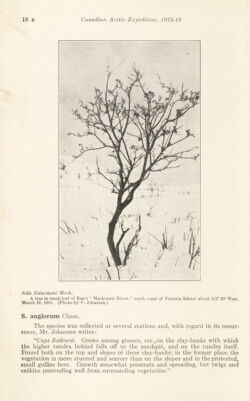
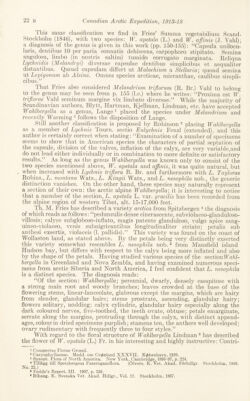
![Salix Richardsonii Hook. F ^ Coppermine river (below Bloody Fall). February 10, 1915. (Photo by _ ^ Pihumalerksiak island, Dolphin and Union Strait, N.W.T. [off Cockburn point—R.M.A.]. The vegetation of this island is rather scarce and stunted owing to its exposed position and poor soil (dolomite-rock or gravel) • it is best developed in depressions, or in shelter of protruding cliff-parties or large boulders the conditions and the vegetation are thus similar to those found on the island (except Chantry island) in the outer harbour at Bernard harbour. The willows in question grew in patches here and there; generally several plants together; growth prostrate, and each plant not nearly as spreading: as '‘Bernard harbour (mainland), Dolphin and Union strait. Very common everywhere, especially on poorer soil (sand, gravel), where it is one of the domin¬ ating plants. On such gravelly and sandy soil with little other vegetation and where more exposed the plant spreads out over the ground (not half buried in tne sand as is the case with S. ovalifolid) in all directions, the whole plant remind- mg one of a huge basket-starfish. The centre of the plant is elevated most ( ick trunk-bases, many dead leaves); and most of the leaves and catkins are ound at the terminal branch-ends, which seem to seek out small depressions in the ground to shelter the twigs. The diameter of a very large plant mav reach a couple of yards; its height over the ground only a few inches. As is the case with other prostrate willows the female catkins are less likely to be blown oil the plants during the winter, where these latter (not the catkins) are sftow- covered. In 1916 the season was several weeks earlier than in 1915, and the catkin-buds were noticed to emerge from their bracts in the end of Mav, 1916- though it took a whole month before the first flowers appeared. In 1915 the first stammate flowers were noticed June 23 and the first pistillate ones (and flowering begins earlier at the coast and on island than farther inland. The flowers in the catkins have the following colours: (1) stammate scales (bractlets) black with purple base and white hairs; small inner scale (bractlet) purple; filament pale-pink; anthers dark rose-purple, turnmg yellow when the pollen came out, later black. (2) pistillate: As the stammate (capsules) dark purple, below with white woolly hairs ” 24657—2§](https://iiif.wellcomecollection.org/image/b29810462_0021.jp2/full/800%2C/0/default.jpg)