Contributions to the morphology, synonymy, and geographical distribution of arctic plants / by Theo. Holm.
- Holm, Theodor (Herman Theodor), 1854-1932.
- Date:
- 1922
Licence: In copyright
Credit: Contributions to the morphology, synonymy, and geographical distribution of arctic plants / by Theo. Holm. Source: Wellcome Collection.
46/144 (page 44)
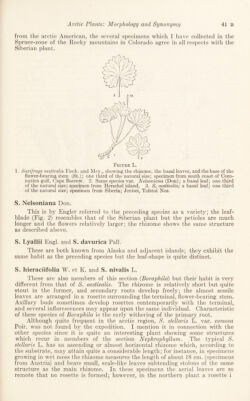
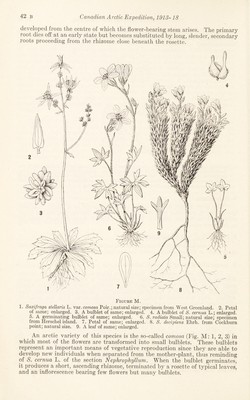
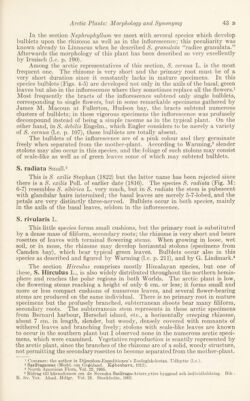
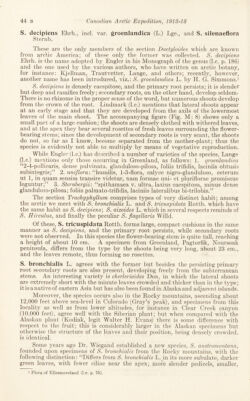
![S. decipiens Ehrh., incl. var. groenlandica (L.) Lge., and S. silenaeflora Sternb. These are the only members of the section Dactyloides which are known from arctic America; of these only the former was collected. S. decipiens Ehrh. is the name adopted by Engler in his Monograph of the genus (he. p. 186) and the one used by the various authors, who have written on arctic botany, for instance: Kjellman, Trautvetter, Lange, and others; recently, however, another name has been introduced, viz.: S. groenlandica L. by H. G. Simmons.^ S. decipiens is densely caespitose, and the primary root persists; it is slender but deep and ramifies freely; secondary roots, on the other hand, develop seldom. There is no rhizome in the proper sense of the word, but numerous shoots develop from the crown of the root. Lindmark (l.c.) mentions that lateral shoots appear at an early stage and that they are developed from the axils of the lowermost leaves of the main shoot. The accompanying figure (Fig. M: 8) shows only a small part of a large cushion; the shoots are densely clothed with withered leaves, and at the apex they bear several rosettes of fresh leaves surrounding the flower¬ bearing stems; since the development of secondary roots is very scant, the shoots do not, so far as I know, become separated from the mother-plant; thus the species is evidently not able to multiply by means of vegetative reproduction. While Engler (l.c.) has described a number of varieties of the species, Lange (l.c.) mentions only those occurring in Greenland, as follows: 1. groenlandica ^^2-4-pollicaris, dense pulvinata, glanduloso-pilosa, foliis trifidis, laciniis obtusis subintegris;” 2. uniflora: “humilis, 1-3-fiora, calyce nigro-glanduloso, ceterum ut 1, in quam sensim transire videtur, nam formae uni- et pluriflorae promiscue leguntur;’^ 3. Sternhergii: ^^spithamaea v. ultra, laxius caespitosa, minus dense glanduloso-pilosa; foliis palmato-trifidis, laciniis lateralibus bi-trilobis.’^ The section Trachyphyllum comprises types of very distinct habit; among the arctic we meet with S. hronchialis L. and S. tricuspidata Rottb. which have the same habit as S. decipiens] S. aizoides L. which in several respects reminds of S. Hirculus, and finally the peculiar S. flagellaris Willd. Of these, S. tricuspidata Rottb. forms large, compact cushions in the same manner as S. decipiens, and the primary root persists, while secondary roots were not observed. In this species the flower-bearing stem is quite tall, reaching a height of about 10 cm. A specimen from Greenland, Pagtorfik, Noursoak peninsula, differs from the type by the shoots being very long, about 23 cm., and the leaves remote, thus forming no rosettes. S. bronchialis L. agrees with the former but besides the persisting primary root secondary roots are also present, developing freely from the subterranean stems. An interesting variety is cherlerioides Don, in which the lateral shoots pe extremely short with the minute leaves crowded and thicker than in the type; it is a native of eastern Asia but has also been found in Alaska and adjacent islands. Moreover, the species occurs also in the Rocky mountains, ascending about 12,000 feet above sea-level in Colorado (Gray’s peak), and specimens from this locality as well as from lower altitudes, for instance in Clear Creek canyon (10,000 feet), agree well with the Siberian plant; but when compared with the Alaskan plant (Kodiak, legit Walter H. Evans) there is some difference with respect to the fruit; this is considerably larger in the Alaskan specimens but otherwise the structure of the leaves and their position, being densely crowded, is identical. Some years ago Dr. Wiegand established a new species, S. austromontana, founded upon specimens of S. hronchialis from the Rocky mountains, with the following distinction: “Differs from S. hronchialis L.pn its more subulate, darker green leaves, with fewer ciliae near the apex; more slender pedicels, smaller, 1 Flora of Ellesmereland (l.c. p. 70).](https://iiif.wellcomecollection.org/image/b29810462_0046.jp2/full/800%2C/0/default.jpg)