Revised translation of the Chahár maqála : ("Four discourses") of Nizámí-i-ʼArúdí of Samarqand, followed by an abridged translation of Mírzá Muhammad's notes to the Persian text / by Edward G. Browne.
- Nizami Aruzi
- Date:
- 1921
Licence: Public Domain Mark
Credit: Revised translation of the Chahár maqála : ("Four discourses") of Nizámí-i-ʼArúdí of Samarqand, followed by an abridged translation of Mírzá Muhammad's notes to the Persian text / by Edward G. Browne. Source: Wellcome Collection.
54/210 page 34
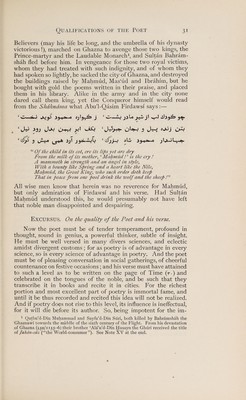
![small-stoned, and luscious, so that you would say they contained no earthly elements. A cluster of Kalanjarf grapes sometimes attains a weight of five maunds, and each individual grape five dirhams’ weight, they are black as pitch and sweet as sugar, and one can eat many by reason of the lusciousness that is in them. And besides these there were all sorts of other delicious fruits. So the Amir Nasr ibn Ahmad saw Mihrgan and its fruits, and was mightily pleased therewith. Then the narcissus began to bloom, and the raisins were plucked and stoned1 in Malin, and hung up on lines, and packed in store-rooms ; and the Amir with his army moved into the two groups of hamlets called Ghura and Darwaz. There he saw mansions of which each one was like highest paradise, having before it a garden or pleasure ground with a northern aspect. There they wintered, while the Mandarin oranges began to arrive from Sfstan and the sweet oranges from Mazandaran ; and so they passed the winter in the most agree¬ able manner. When [the second] spring came, the Amir sent the horses to Badghfs and moved his camp to Malin [to a spot] between two streams. And when summer came and the fruits again ripened, Amir Nasr ibn Ahmad said, “Where shall we go for the summer ? For there is no pleasanter place of residence than this. Let us wait till Mihrgan.” And when Mihrgan came, he said, “ Let us enjoy Mihrgan at Herat and then go”; ahd so from season to season he continued to procrastinate, until four years had passed in this way. For it was then the heyday of the Samanian pro¬ sperity, and the land was flourishing, the kingdom unmenaced by foes, the army loyal, fortune favourable, and heaven auspicious ; yet withal the Amir’s attendants grew weary, and desire for home arose within them, while they beheld the king quiescent, the air of Herat in his head and the love of Herat in his heart; and in the course of conversation he would compare, nay, prefer Herat to the Garden of Eden, and would exalt its charms above those of a Chinese temple2. So they perceived that he intended to remain there for that summer also. Then the captains of the army and nobles of the kingdom went to Master Abu ‘Abdi’llah Riidagf3, than whom there was none more honoured of the king’s intimates, and none whose words found so ready an acceptance. And they said to him, “We will present thee with five thousand dinars if thou wilt contrive some artifice whereby the king may be induced to depart I* or this meaning of munaqqa the editor refers to the article Zabib in the Tuhfath?I-Mu’niintn of Muhammad Mu’min al-Husayni. For an account of this work, which was completed in a.d. 1669, see Fonahn’s Zur Quellenkunde der Persisclien Medizin, pp. 89-91. 2 Or “ Chinese Spring.” Seen. 2 on p. 22 supra. 3 See Ethe’s excellent monograph and his article in the Encyclopaedia Britannica; p. 62 of thz J.R.A.S. for January, 1899 ; and Note XIV at the end, second paragraph.](https://iiif.wellcomecollection.org/image/b31349778_0054.jp2/full/800%2C/0/default.jpg)




 No text description is available for this image
 No text description is available for this image
 No text description is available for this image