An introduction to human physiology / by Augustus D. Waller.
- Waller, Augustus.
- Date:
- 1896
Licence: Public Domain Mark
Credit: An introduction to human physiology / by Augustus D. Waller. Source: Wellcome Collection.
Provider: This material has been provided by University of Bristol Library. The original may be consulted at University of Bristol Library.
225/678 page 207
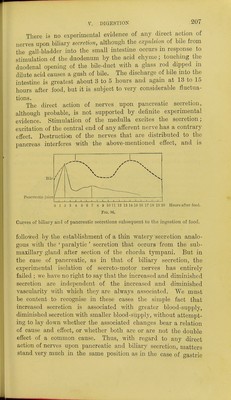
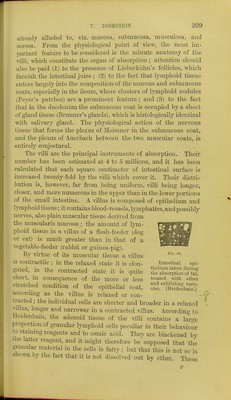
![There is no experimeutal evidence of any direct action of nerves upon biliary secretion, although the exjmlsion of bile from the gall-bladder into the small intestine occurs in response to stimulation of the duodenum by the acid chyme; touching the duodenal opening of the bile-duct with a glass rod dipped in dilute acid causes a gush of bile. The discharge of bile into the intestine is greatest about 3 to 5 hours and again at 13 to 15 hours after food, but it is subject to very considerable fluctua- tions. The direct action of nerves upon pancreatic secretion, although probable, is not supported by definite experimental evidence. Stimulation of the medulla excites the secretion; excitation of the central end of any afferent nerve has a contrary effect. Destruction of the nerves that are distributed to the pancreas interferes with the above-mentioned effect, and is Bile /] / / 1 / < 1 1 \ V.../X Pancreatic juioe 1 1 1 1 I 1 1 1 1 1 1 I t 1 t 1 1 1 1 0123456789 10 11 12 13 14 15 16 17 18 19 20 Hours after food. Fig. 86. Curves of biliary and of pancreatic secretions subsequent to the ingestion of food. followed by the establishment of a thin watery secretion analo- gous with the ' paralytic ' secretion that occurs from the sub- maxillary gland after section of the chorda tympani. But in the case of pancreatic, as in that of biliary secretion, the experimental isolation of secreto-motor nerves has entirely failed ; we have no right to say that the increased and diminished secretion are independent of the increased and diminished vascularity with which they are always associated. We must be content to recognise in these cases the simj)le fact that increased secretion is associated with greater blood-supply, diminished secretion with smaller blood-supply, without attempt- ing to lay down whether the associated changes bear a relation of cause and effect, or whether both are or are not the double effect of a common cause. Thus, with regard to any direct action of nerves upon pancreatic and biliary secretion, matters stand very much in the same position as in the case of astric](https://iiif.wellcomecollection.org/image/b21443981_0225.jp2/full/800%2C/0/default.jpg)
 No text description is available for this image
 No text description is available for this image
 No text description is available for this image