An introduction to human physiology / by Augustus D. Waller.
- Waller, Augustus.
- Date:
- 1896
Licence: Public Domain Mark
Credit: An introduction to human physiology / by Augustus D. Waller. Source: Wellcome Collection.
Provider: This material has been provided by University of Bristol Library. The original may be consulted at University of Bristol Library.
86/678 (page 68)
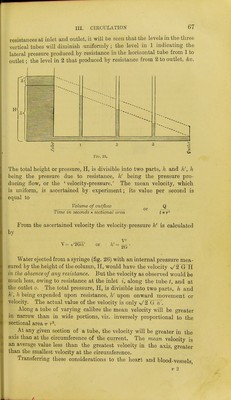
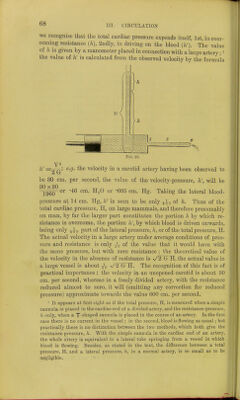
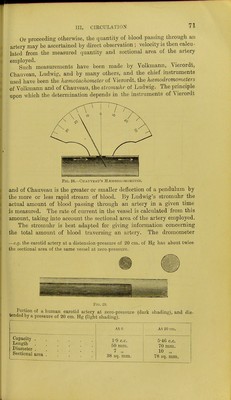
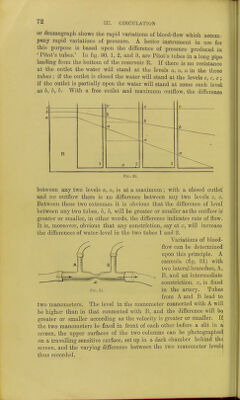
![we recognise that the total cardiac pressure expends itself, 1st, in over- coming resistance [h], 2ndly, in driving on the blood {h'). The value of h is given by a manometer placed in connection with a large artery ;' the value of h' is calculated from the observed velocity by the formula Fig. 2C. h' =2q; <^-9- tlie velocity in a carotid artery having been observed to be 30 cm. per second, the value of the velocity-pressure, h', will be tSO X 30 Togo '^^ '^^^ '^^^^^S ttie lateral blood- pressure at 14 cm. Hg, h' is seen to be only of h. Thus of the total cardiac pressure, H, on large mammals, and therefore presumably on man, by far the larger part constitutes the portion h by which re- sistance is overcome, the portion /i', by which blood is driven onwards, being only ^i-^ part of the lateral pressure, h, or of the total pressure, H. The actual velocity in a large artery under average conditions of pres- sure and resistance is only of the value that it would have with the same pressure, but with zero resistance ; the theoretical value of the velocity in the absence of resistance is s/ti G H, the actual value in a large vessel is about -^V \/2 Gr H. The recognition of this fact is of practical importance : the velocity in an unopened carotid is about 30 cm. per second, whereas in a freely divided artery, with the resistance reduced almost to zero, it will (omitting any correction for reduced pressure) approximate towards the value 600 cm. per second. ' It appears at first sight as if the total pressure, H, is measured when a simple cannula is placed in the cardiac end of a divided artery, and the resistance-pressure, h only, -when a T'Shaped cannula is placed in the course of an artery. In the first case there is no current in the vessel; in the second, blood is flowing as usual; but practically there is no distinction between the two methods, which both give the resistance-pressure, h. With the simple cannula in the cardiac end of an artery, the whole artery is equivalent to a lateral tube springing from a vessel in which blood is flowing. Besides, as stated in the text, the difference between a total pressure, H, and a lateral pressure, h, in a normal aitery, is so small as to be negligible.,](https://iiif.wellcomecollection.org/image/b21443981_0086.jp2/full/800%2C/0/default.jpg)