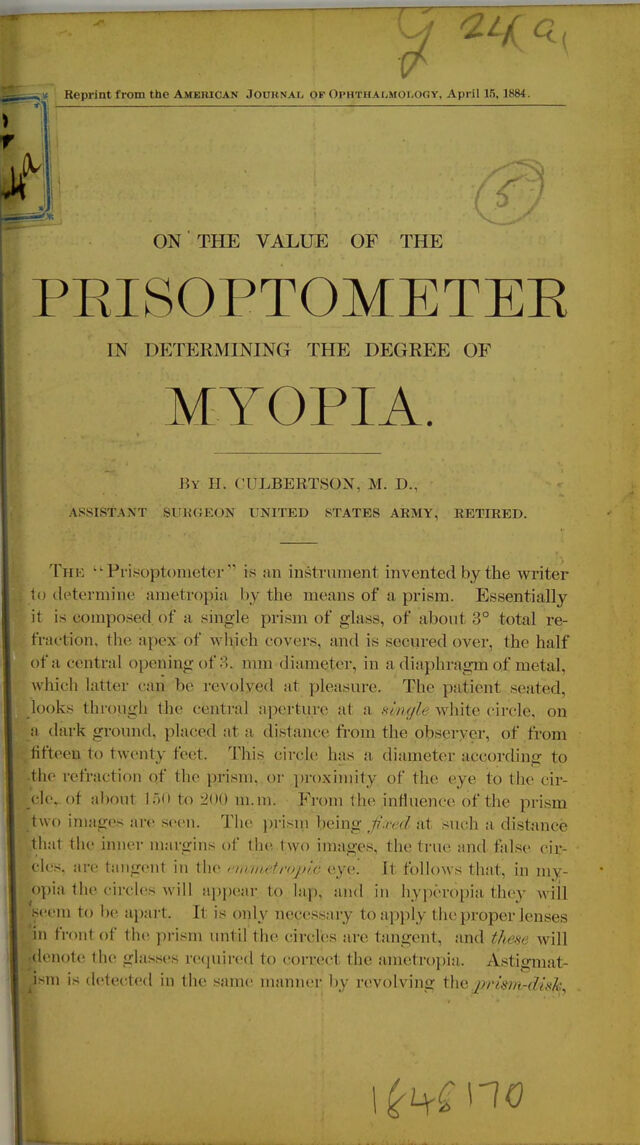
On the value of the prisoptometer in determining the degree of myopia / by H. Culbertson.
- Culbertson, H. (Howard), 1828-1890
- Date:
- [1884]
Licence: Public Domain Mark
Credit: On the value of the prisoptometer in determining the degree of myopia / by H. Culbertson. Source: Wellcome Collection.
Provider: This material has been provided by UCL Library Services. The original may be consulted at UCL (University College London)
11/14 page 7
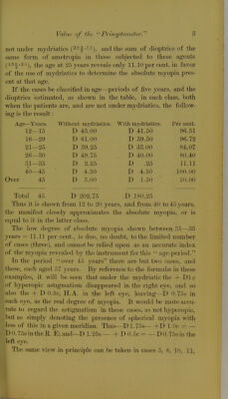
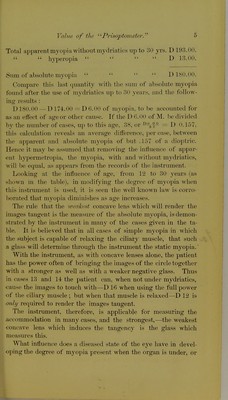
![and its effects pass off sooner, it may be preferred to the latter agent. This conclusion is based upon the cases of the table, but experience with the use of hyoscine corroborates this view. In genera] a larger number of eases may change the results formed in these examples of myopia, still they point to the value of the instrument in detecting myopia. As is well known, hyperopia may mask myopia, the degree so covered is shown as follows : Total myopia found jiftpr use of <3ase. mydriatics. 5 I) 1.50 s D 1.00 9 D 1.00 17 D 0.75 18 D 0.75 . 22 - - D 0.50 D 0.50 25 1) 0.50 26 D 1.25 31 D 2.50 32 D 2.25 35 D 1.25 36 D 0.75 Cases 13 I) 14.50 = 80.65 per cent. Thus in the 13 cases showing hyperopia, there is 14.50 diop- trics of absolute myopia. In the same cases there has been found 13.00 dioptrics of hypermetropia. Compare these as 14.50: 13.00:: 100.00: 89.65 per cent. That is all save 10.35 per cent, of the myopia of tlx^e 13 eases is masked by hypermetropia. CONCLUSIONS. 1. That the maximum of apparent myopia is greater in those not subjected to mydriatics, as determined by the instrument. 2. That in many eases the mydriatic and non^m/driatic myo- pia are equal. 3. That in many cases of simple myopia, the accommodative myopia can bedetermined with the instrument, and hence the force of that muscle ascertained through its agency. 1. That hyperopia may mask a large proportion of the myo- pia. 89.65 percent., when mydriatics are not employed.](https://iiif.wellcomecollection.org/image/b21648013_0011.jp2/full/800%2C/0/default.jpg)