Memoir of the medicinal action of arsenic : collected from the reported experience of the members of the Provincial Medical and Surgical Association, and other sources / by Thomas Hunt.
- Hunt, Thomas, 1798-1879.
- Date:
- 1849
Licence: Public Domain Mark
Credit: Memoir of the medicinal action of arsenic : collected from the reported experience of the members of the Provincial Medical and Surgical Association, and other sources / by Thomas Hunt. Source: Wellcome Collection.
Provider: This material has been provided by The Royal College of Surgeons of England. The original may be consulted at The Royal College of Surgeons of England.
23/42 (page 23)
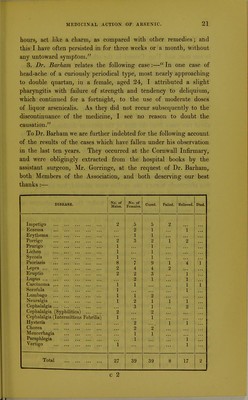
![from what was regarded as hopeless consumption; he rallied in his new employment, and has now enjoyed good health for a long period. A friend of Dr. Barham attributes his recovery from an inter- mittent febrile affection, contracted in India, and slightly returning in England for ten years together, to the vapours of arsenic, diffused in his apartments from some stearine candles which he used. Dr. Elliotson has combined arsenic with hydrocyanic acid and creosote, to prevent the sickness occasioned by it. Mr. Evan Evans does not remember any case, either of inter- mittent or cutaneous disease, in which the administration of arsenic did not ultimate in cure. Mr. I. B. Brown has frequently succeeded in curing Essex intermittent fevers with arsenic, after the use of bark and quinine had failed. Dr. Henry Cooper, of Hull, says he has substituted arsenic for antimony, in the preparation of tartar emetic, and given one-sixteenth of a grain of the salt (tartrate of arsenic and potass,) as a dose. It is more soluble than the arsenious acid. Dr. Cowan says, Practitioners in my neighbourhood are generally averse to what they term 'strong remedies/ and there is a popular objection to the idea of arsenic particularly. From this springs a tendency to saddle it with all conceivable consequences, and the post hoc argument is sure of its application. [Query. Is Berkshire the only county in England in which the progress of science is hindered by popular objections ?] Dr. William Dix writes, During my apprenticeship in Norfolk, near the coast, the prevalence of ague was so great, that we have used in the year fifteen wine-quarts of Fowler's Solution, in a population of forty-five incorporated parishes (under Gilbert's act.) I have scarcely ever cured a case of intermittent fever, during a practice of nearly forty years, with any drug but arsenic, which I have administered with the most gratifying results. Mr. Bainbridge gives the details of a case of secondary syphilis benefitted by arsenic, in a very satisfactory degree. Mr. Bainbridge was led to its adoption by the general coldness and chilliness of the surface, an indication which he and other correspondents have observed as favourable to the useful action of arsenic.](https://iiif.wellcomecollection.org/image/b2228218x_0025.jp2/full/800%2C/0/default.jpg)