A manual of practical hygiene : prepared especially for use in the medical service of the army / by Edmund A. Parkes.
- Parkes, Edmund A. (Edmund Alexander), 1819-1876.
- Date:
- 1864 ;
Licence: Public Domain Mark
Credit: A manual of practical hygiene : prepared especially for use in the medical service of the army / by Edmund A. Parkes. Source: Wellcome Collection.
Provider: This material has been provided by the Harvey Cushing/John Hay Whitney Medical Library at Yale University, through the Medical Heritage Library. The original may be consulted at the Harvey Cushing/John Hay Whitney Medical Library at Yale University.
27/686 page 3
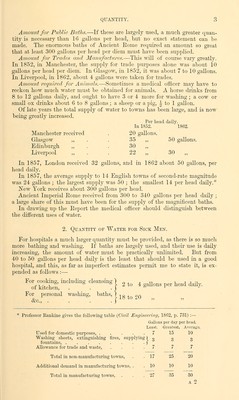
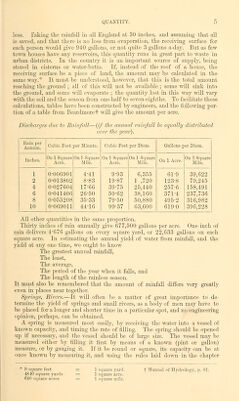
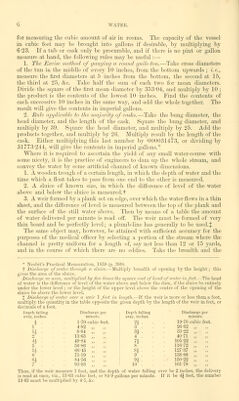
![Amount for Public Baths.—If these are largely used, a much, greater quan- tity is necessary than 16 gallons per head, hut no exact statement can he made. The enormous haths of Ancient Rome required an amount so great that at least 300 gallons per head per diem must have heen supplied. Amount for Trades and Manufactures.—This will of course vary greatly. In 1852, in Manchester, the supply for trade purposes alone was ahout 10 gallons per head per diem. In Glasgow, in 1852, it was ahout 7 to 10 gallons. In Liverpool, in 1862, ahout 4 gallons were taken for trades. Amount required for Animals.—Sometimes a medical officer may have to reckon how much water must he obtained for animals. A horse drinks from 8 to 12 gallons daily, and ought to have 3 or 4 more for washing; a cow or small ox drinks ahout 6 to 8 gallons; a sheep or a pig, J to 1 gallon. Of late years the total supply of water to towns has heen large, and is now being greatly increased. Per head daily. In 1852. 1862. Manchester received . 20 gallons. Glasgow ,, . . 35 „ 50 gallons. Edinburgh „ . . 30 „ Liverpool „ . 22 „ 30 „ In 1857, London received 32 gallons, and in 1862 about 50 gallons, per head daily. In 1857, the average supply to 14 English towns of second-rate magnitude was 24 gallons ; the largest supply was 50 ; the smallest 14 per head daily.* Xew York receives about 300 gallons per head. Ancient Imperial Eome received from 300 to 340 gallons per head daily ; a large share of this must have been for the supply of the magnificent baths. In drawing up the Eeport the medical officer shoidd distinguish between the different uses of water. 2. Quantity of \Yater fob Sick Men. For hospitals a much larger quantity must be provided, as there is so much more bathing and washing. If baths are largely used, and their use is daily increasing, the amount of water must be practically unlimited. But from 40 to 50 gallons per head daily is the least that shoidd be used in a good hospital, and this, as far as imperfect estimates permit me to state it, is ex- pended as follows :— For cooking, including cleansing) _ . ,, , , , ., n-. ., -i ° ° ° 2 to 4 gallons per head daily. For personal washing, baths, ] -, Q , 1Ct &C, . . . _ | 1» to _U „ * Professor Eankine gives the following table (Civil Engineering, 1862, p. 731) :— Gallons per day per head. Least. Greatest. Average. Used for domestic purposes, ..... 7 Washing sheets, extinguishing fires, supplying) fountains, ........ j Allowance for trade and waste, Total in non-manufacturing towns, Additional demand in manufacturing towns. Total in manufacturing towns, 7 15 10 3 3 3 7 7 7 17 25 20 10 10 10 27 35 30](https://iiif.wellcomecollection.org/image/b21008747_0027.jp2/full/800%2C/0/default.jpg)