Volume 1
The trial of Elizabeth Duchess Dowager of Kingston for bigamy, before the Right Honourable the House of Peers, in Westminster-Hall, in full Parliament, on Monday the 15th, Tuesday the 16th, Friday the 19th, Saturday the 20th, and Monday the 22d of April, 1776. On the last of which days the said Elizabeth duchess dowager of Kingston was found guilty / Published by order of the House of Peers.
- Elizabeth Pierrepont, Duchess of Kingston-upon-Hull
- Date:
- 1776
Licence: Public Domain Mark
Credit: The trial of Elizabeth Duchess Dowager of Kingston for bigamy, before the Right Honourable the House of Peers, in Westminster-Hall, in full Parliament, on Monday the 15th, Tuesday the 16th, Friday the 19th, Saturday the 20th, and Monday the 22d of April, 1776. On the last of which days the said Elizabeth duchess dowager of Kingston was found guilty / Published by order of the House of Peers. Source: Wellcome Collection.
184/192 page 174
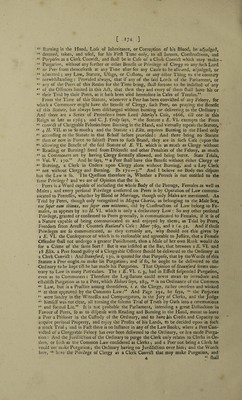
![I * . [ 174 ] 44 Burning in the Hand, Lofs of Inheritance, or Corruption of his Blood, be adjudged, “ deemed, taken, and ufed, for his Firft Time only, to all Inrents, Conftrudions, and <s Purpofes as a Clerk Convict, and fhall be in Cafe of a Clerk Convid which may make .. “ Purgation, without any further or other Benefit or Privilege of Clergy to any fuch Lord “ or Peer from thenceforth at any Time after for any Caufe to be allowed, adjudged, or “ admitted ; any Law, Statute, Ufage, or Cuftom, or any other Thing to the contrary <{ notwithftanding : Provided always, that if any of the faid Lords of the Parliament, or 4t any of the Peers of this Realm for the Time being, fhall fortune to be indided of any 44 of the Offences limited in this Ad, that then they and every of them fhall have his or “ their Trial by their Peers, as it haih been ufed heretofore in Cafes of Treafond* From the Time of this Statute, whenever a Peer has been convicted of any Felony, for which a Commoner might have the Benefit of Clergy, fuch Peer, on praying the Benefit of this Statute, has always been difcharged without burning or delivering to the Ordinary: And there are a Series of Precedents from Lord Morley’s Cafe, 1666, till one in this Reign as late as 1765 ; and C. J. Treby fays, 44 the Statute 1 E. VI. exempts the Peers 44 convid of Clergyable Felonies from Burning in the Hand, and virtually repeals the Statute, 44 4 H. VII. as to fo much; and the Statute 18 Eliz. requires Burning in the Hand only 44 according to the Statute in that Behalf before provided : And there being no Statute “ then or now in Force to fubjeCt Peers to fuch Brand, they are in fuch Cafe (upon the “ allowing the Benefit of the faid Statute of E. VI. which is as much as Clergy without 44 Reading or Burning) freed from Difcredit and other Penalties of the Felony, as mudh 44 as Commoners are by having Clergy formally allowed, and being burnt. State Trials, 44 Vol. V. 170.” And he fays, 44 a Peer fhall have this Benefit without either Clergy or “ Burning, a Clerk in Orders upon Clergy alone without Burning, and a Lay Clerk “ not without Clergy and Burning. Ib. 172—3/* And I believe no Body can difpute but the Law is fo. The Queftion therefore is. Whether a Peerefs is not entitled to the fame Privilege ? and we are of Opinion that (he is. Peers is a Word capable of including the whole Body of the Peerage, Females as well as Males ; and every perfonal Privilege conferred on Peers is by Operation of Law commu¬ nicated to Peerefies, whether by Blood or Marriage, though only Males are mentioned. As Trial by Peers, though only recognized in Magna Chart a, as belonging to the Male Sex, rice fuper eum ibimus, nec fuper eum mittemus, did by ConftruCtion of Law belong to Fe¬ males, as appears by 20 H. VI. which is only a declaratory Law : So any other perfonal Privilege, granted or confirmed to Peers generally, is communicated to Females, if it is of a Nature capable of being communicated to and enjoyed by them; as Trial by Peers, Freedom from Arreft : Countefs Rutland’s Cafe : Moor 769, and 2 Co. 52. And if thofe Privileges are fo communicated, as they certainly are, why Ihould not this given by 1 E. VI. the Confequence of which is io reafonable and agreeable to Juftice, that a Female Offender fhall not undergo a greater Punifhment, than a Male of her own Rank would do for a Crime of the fame Sort ? But it was infilled at the Bar, that between 1 E. VI. and 18 Eliz. a Peer found guilty of a Clergyable Offence fhould be delivered to the Ordinary as a Clerk Convid: And Stamford, 130, is quoted for that Purpofe, that by theWords of this Statute a Peer ought.to make his Purgation; and if fo, he ought to be delivered to the Ordinary to be kept till he has made his Purgation. That Opinion of Stauriford feems con¬ trary to Law in many Particulars. The 1 E. VI. c. 3, had in Effed fufpended Purgation, even as to Commoners : Therefore the Legiflature could never mean to introduce and eftablifh Purgation as to a Peer, which Hobart fays, 289, “ is no Ordinance of the Common 44 Law, but is a Pradice among themfelves, i. e. the Clergy, rather overfeen and winked 44 at than approved by the Common LawAnd Page 291, he fays, 44 the Perjuries 44 were fundry in the Witnelfes and Compurgators, in the Jury of Clerks, and the Judge 44 himi'df was not clear, all turning the folemn Trial of Truth by Oath into a ceremonious 44 and formal Lie.’* It is not probable the Parliament, intending a great DiftinCtion in Favour of Peers, fo as to difpenfe with Reading and Burning in the Hand, meant to leave a Peer a Prifoner in the Cuftody of the Ordinary, and to haveiiis Credit and Capacity to acquire perfonal Property, and enjoy the Profits of his Lands, to be decided upon in fuch a mock Trial ; and in Fad there is no Inftance in any of the Law Books, where a Peer Con¬ victed of a Clergyable Felony has ever been delivered to the Ordinary, or has made Purga¬ tion : And the Jurifdidion of the Ordinary to purge the Clerk only relates to Clerks in Or¬ ders, or fuch as the Common Law confidered as Clerks; and a Peer not being a Clerk he could not make Purgation ; the Ordinary having no Jurifdidion over him ; and the Words here, 44 have the Privilege of Clergy as a Clerk ConviCt that may make Purgation, and](https://iiif.wellcomecollection.org/image/b30458961_0001_0184.jp2/full/800%2C/0/default.jpg)