Volume 1
A dictionary of the English language : in which the words are deduced from their origin and illustrated in their different significations by examples from the best writers. To which are prefixed a History of the language, and an English grammar / By Samuel Johnson.
- Samuel Johnson
- Date:
- 1820
Licence: Public Domain Mark
Credit: A dictionary of the English language : in which the words are deduced from their origin and illustrated in their different significations by examples from the best writers. To which are prefixed a History of the language, and an English grammar / By Samuel Johnson. Source: Wellcome Collection.
Provider: This material has been provided by Royal College of Physicians, London. The original may be consulted at Royal College of Physicians, London.
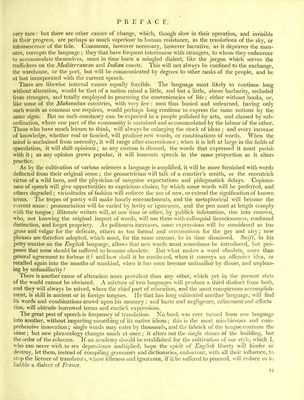
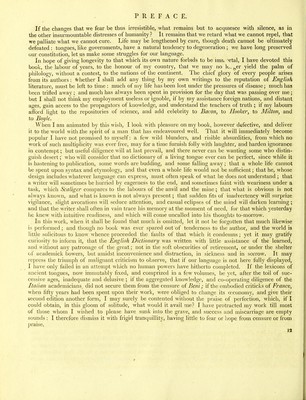
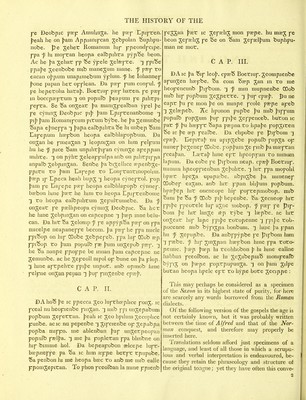
27/1126 page 1
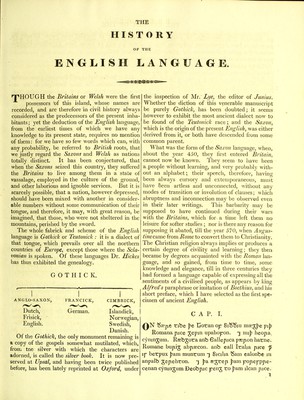
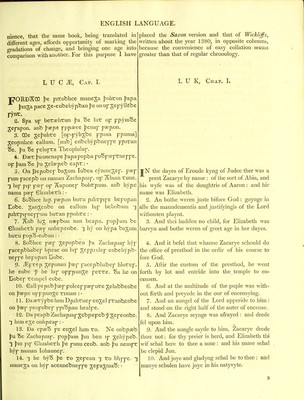
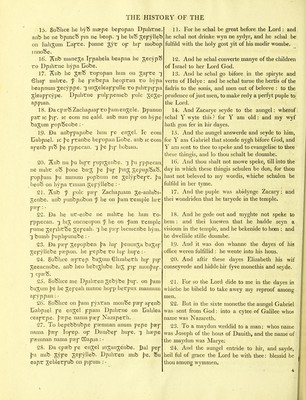
![THE HISTORY OF THE ENGLISH LANGUAGE. nPHOUGH the Britains or Welsh were the first possessors 'of this island, whose names are recorded, and are therefore in civil history always considered as the predecessors of the present inha- bitants ; yet the deduction of the English language, from the earliest times of which we have any knowledge to its present state, requires no mention of them: for we have so few words which can, with any probability, be referred to British roots, that we justly regard the Saxons and Welsh as nations totally distinct. It has been conjectured, that when the Saxons seized this country, they suffered the Britains to live among them in a state of vassalage, employed in the culture of the ground, and other laborious and ignoble services. But it is scarcely possible, that a nation, however depressed, should have been mixed with another in consider- able numbers without some communication of their tongue, and therefore, it may, with great reason, be imagined, that those, who were not sheltered in the mountains, perished by the sword. The whole fabrick and scheme of the English language is Gothick or Teutonick : it is a dialect of that tongue, which prevails over all the northern countries of Europe, except those where the Scla- vonian is spoken. Of these languages Dr. Hickes has thus exhibited the genealogy. GOTHICK. ANGLO-SAXON, FRANCICK, CIMBRICK, Dutch, Frisick, English. German. Islandick, Norwegian, Swedish, Danish. Of the Gothick, the only monument remaining is a copy of the gospels somewhat mutilated, which, from tne silver with which the characters are adorned, is called the silver book. It is now pre- served at Upsal, and having been twice published before, has been lately reprinted at Oxford, under the inspection of Mr. Lye, the editor of Junius. Whether the diction of this venerable manuscript be purely Gothick, has been doubted; it seems however to exhibit the most ancient dialect now to be found of the Teutonick race; and the Saxon, which is the origin of the present English, was either derived from it, or both have descended from some common parent. What was the form of the Saxon language, when, about the year 450, they first entered Britain, cannot now be known. They seem to have been a.people without learning, and very probably with- out an alphabet; their speech, therefore, having been always cursory and extemporaneous, must have been artless and unconnected, without any modes of transition or involution of clauses; which abruptness and inconnection may be observed even in their later writings. This barbarity may be supposed to have continued during their wars with the Britains, which for a time left them no leisure for softer studies ; nor is there any reason for supposing it abated, till the year 570, when Augus- tinec&me from Rome to convert them to Christianity. The Christian religion always implies or produces a certain degree of civility and learning; they then became by degrees acquainted with the Roman lan- guage, and so gained, from time to time, some knowledge and elegance, till in three centuries they had formed a language capable of expressing all the sentiments of a civilised people, as appears by king Alfred's paraphrase or imitation of Boethius, and his short preface, which I have selected as the first spe- cimen of ancient English. CAP. I. QN ^aep.e tribe ye Doran op SiSSiu masgpe pij> Romana pice gepin upahopon. 3 mij? heorta, cymngum. Rsebgota anb Galleruca pjejion harne. Romane bujiig abjiascon. anb call Iralia pice -p ly berpux J?am munrum -j Sicilia Sam ealonbe in anpalb gejiehron. ~] J?a ?egrep Jjam porter-ppe- cenan cyningum Deobriic jreirg ro j?am llcan pice.](https://iiif.wellcomecollection.org/image/b22651378_0001_0027.jp2/full/800%2C/0/default.jpg)