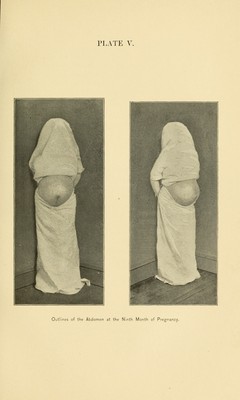
A text-book of practical obstetrics / by Egbert H. Grandin ... with the collaboration of George W. Jarman.
- Grandin, Egbert H. (Egbert Henry), 1855-
- Date:
- 1898
Licence: Public Domain Mark
Credit: A text-book of practical obstetrics / by Egbert H. Grandin ... with the collaboration of George W. Jarman. Source: Wellcome Collection.
Provider: This material has been provided by the Harvey Cushing/John Hay Whitney Medical Library at Yale University, through the Medical Heritage Library. The original may be consulted at the Harvey Cushing/John Hay Whitney Medical Library at Yale University.
54/616 page 24
![rectum may give rise to haemorrhages, and that in an obscure case the lower bowel should be examined. The mistakes made by em- inent men should serve as a warning never to rest satisfied with a superficial examination. Long-standing congestion of the pelvic organs may lead to the presence of many of the early symptoms of pregnancy. The nausea and vomiting, the bluish discoloration of the vagina, the enlarge- ment of the uterus, the apparent softening of the cervix, the en- largement of the abdomen, the mammary signs,—all these symp- toms may exist and yet pregnancy be absent. Here, again, careful examination and a proper appreciation of the signs should serve to guard against error in diagnosis. The uterus will never be found to have the spherical outline which may be determined even at a very early stage of gestation in the nullipara, and with less exact- itude in the pluripara. The apparent softening of the cervix will, on inspection, be found dependent on an erosion of the epithelial layer of the cervix, the result of acrid discharge from the uterus; the enlargement of the abdomen may be determined as due to the constipation which is such a frequent associate of pelvic congestion; the sensation of foetal motion will be determined as due to the presence of flatus in the intestines. Fibroid tumors of the uterus may at times render the diagnosis of pregnancy difficult. This will especially be the case in women with a large amount of adipose in the abdominal walls. Whenever careful bimanual examination is possible, however, the differentia] diagnosis ought not to present difficulties. The cervical signs of pregnancy are absent; the uterine outline is not apt to be spherical unless the fibroid is symmetrical, and then the consistency of the uterus is harder than in pregnancy, and. instead of amenorrhoea, the menstrual flow is either natural and regular or else there is a history of haemorrhages. The rational signs of pregnancy will rarely be present,—after a suggestive manner, if at all. If the fibroid be subperitoneal, on careful palpation the tumor will be found independent of the uterus or projecting in a nodular fashion from it. Of course, the two conditions, fibroid and pregnancy, may](https://iiif.wellcomecollection.org/image/b21022501_0054.jp2/full/800%2C/0/default.jpg)