The pathology, diagnosis, and treatment of the diseases of women / by Graily Hewitt.
- Date:
- 1882
Licence: Public Domain Mark
Credit: The pathology, diagnosis, and treatment of the diseases of women / by Graily Hewitt. Source: Wellcome Collection.
Provider: This material has been provided by the Royal College of Physicians of Edinburgh. The original may be consulted at the Royal College of Physicians of Edinburgh.
923/948 (page 887)
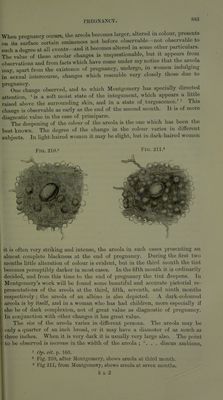
![woman ever yet fancied herself pregnant without also persuading herself that she felt the motions of the child.' In women with abduminal tumours, sensations of movement are some- times present; in cases of ovarian tumour, an irregular pulsatile sensation is sometimes perceived, due, probably, to the pulsations of the aorta or of the great vessels lying behind and pressed upon by the tumours in question. Where the uterus is distended by retention of menstrual fluid, by presence of the ovum in a condition of hydatidiform degeneration, or otherwise, and sensations like those due to motions of a child are present, the cause of the same is probably the contraction of the uterine muscular fibres. Dr. Mont- gomery relates three cases in which these anomalous sensations of motion were due to presence of 'hydatid pregnancy.' The sensation was dift'erent from that experienced in ordinary pregnancy, and was described as a peculiar crawling or sliding sensation. Comparative istimate of the value of different signs of pregnancy.—Perfect evidence of the existence of pregnancy is not obtainable until after the tliird month, unless in those very rare cases where the fcetal heart may be heard just at the end of this time. The evidence obtainable before this date only enables us to come to the conclusion that pregnancy is probable. The signs (probable ones) of j^regnancy up to this time are—suppression of the menses, swelling of the breasts, descent of the lower part of the uterus in the pelvis, flattening of the abdomen.' An examination will not usually enable us to give a positive opinion, if inidertaken at this time. After the end of the third month, during the fourth and fifth, an ab- dominal and a vaginal examination give, or may give, decisive indications. Menstruation is still absent in ordinary cases ; the breasts continue to en- large, and the areolar changes become developed ; the os uteri undergoes its characteristic changes ; the uterus can be felt to be enlarged from the vagina and above the pubes ; the vagina assumes a dusky hue ; the motions of the foetus can be felt by the observer and by the patient; ballottement is recog- nisable ; the sounds of the foetal hfeart can be heard. After the fifth month and up to the end of pregnancy, the symptoms just described continue and become intensified. The signs of pregnancy have been divided into three classes by Mont- gomery—(1) Presumptive ; (2) probable ; (3) unequivocal. Practically, how- ever, there is no great difference between what is i^resuniptive and what is probable ; and if distinctions are to be drawn between shades of belief, the division might be extended ad hifinitum. It appears quite suflicient to arrange these signs under two classes—(1) the certain, and (2) the probable, signs of pregnancy. 1. The certahi sigibs of pregnancy are— The active movements of the child unequivocally felt by another ; The presence of the child in utero ascertained by ballottement; The sounds produced by the pulsations of the fcetal heart. A positive opinion may be expressed if any one of these be distinctly ' This flattening of the abdomen was reckoned by tlie older authorities as an early sign of pregnancy. ' En ventre plat p]nfant 11 y a.' Thus ran the old proverb. Montgomery, op. rit. p. 1.57.](https://iiif.wellcomecollection.org/image/b21959894_0923.jp2/full/800%2C/0/default.jpg)