Organisation of air raid casualties services / issued by the Home Office (Air Raid Precautions Department).
- Date:
- 1938
Licence: Public Domain Mark
Credit: Organisation of air raid casualties services / issued by the Home Office (Air Raid Precautions Department). Source: Wellcome Collection.
23/36 page 21
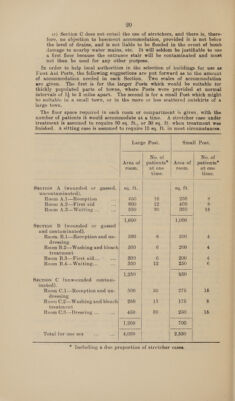
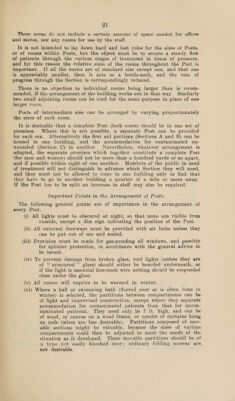
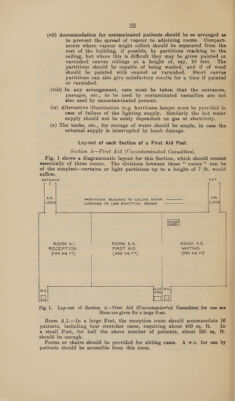
![2] These areas do not include a certain amount of space needed for offices and stores, nor any rooms for use by the staff. It is not intended to lay down hard and fast rules for the sizes of Posts, or of rooms within Posts, but the object must be to secure a steady flow ° of patients through the various stages of treatment in times of pressure, and for this reason the relative sizes of the rooms throughout the Post is important. If all the rooms are of standard size except one, and that one is appreciably smaller, then it acts as a bottle-neck, and the rate of progress through the Section is correspondingly reduced. There is no objection to individual rooms being larger than is recom- mended, if the arrangement of the building works out in that way. Similarly two small adjoining rooms can be used for the same purpose in place of one larger room. Posts of intermediate size can be arranged by varying proportionately the sizes of each room. It is desirable that a complete Post (both sexes) should be in one set of premises. Where this is not possible, a separate Post can be provided for each sex. Alternatively the first aid portions (Sections A and B) can be housed in one building, and the accommodation for contaminated un- wounded (Section C) in another. Nevertheless, whatever arrangement is adopted, the separate premises which together constitute a complete Post (for men and women) should not be more than a hundred yards or 80 apart, and if possible within sight of one another. Members of the public in need of treatment will not distinguish in advance which Section they will need, and they must not be allowed to come to one building only to find that they have to go to another building a quarter of a mile or more away. If the Post has to be split an increase in staff may also be required. Important Points in the Arrangement of Posts. The following general points are of importance in the arrangement of every Post. (i) All lights must be obscured at night, so that none are visible from outside, except a dim sign indicating the position of the Post. (ii) All external doorways must be provided with air locks unless they can be put out of use and sealed. (iii) Provision must be made for gas-proofing all windows, and possibly for splinter protection, in accordance with the general advice to be issued. (iv) To prevent damage from broken glass, roof lights (unless they are of ‘‘ armoured ”’ glass) should either be boarded underneath, or if the light is essential fine-mesh wire netting should be suspended close under the glass. (v) All rooms will require to be warmed in winter. (vi) Where a hall or swimming bath (floored over as is often done in winter) is selected, the partitions between compartments can be of light and improvised construction, except where they separate accommodation for contaminated patients from that for uncon- taminated patients. They need only be 7 ft. high, and can be of wood, or canvas on a wood frame, or consist of curtains hung on rods (wires are less desirable). Partitions composed of mov- able sections might be valuable, because the sizes of various compartments could then be adjusted to meet the needs of the situation as it developed. These movable partitions should be of a type not easily knocked over: ordinary folding screens are not desirable.](https://iiif.wellcomecollection.org/image/b32174779_0023.jp2/full/800%2C/0/default.jpg)