Organisation of air raid casualties services / issued by the Home Office (Air Raid Precautions Department).
- Date:
- 1938
Licence: Public Domain Mark
Credit: Organisation of air raid casualties services / issued by the Home Office (Air Raid Precautions Department). Source: Wellcome Collection.
26/36 page 24
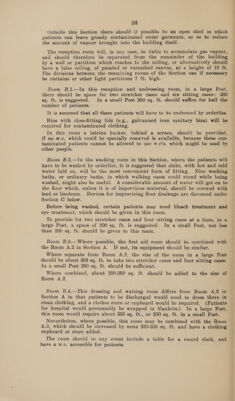
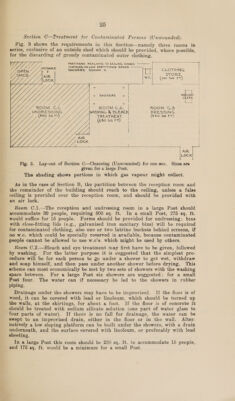
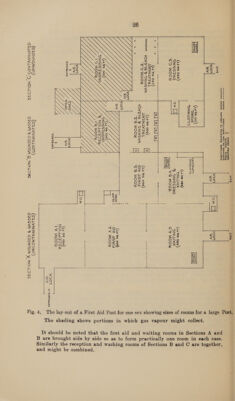
![Outside this Section there should if possible be an open shed in which patients can leave grossly contaminated outer garments, so as to reduce the amount of vapour brought into the building itself. The reception room will, in any case, be liable to accumulate gas vapour, and should therefore be separated from the remainder of the building by a wall or partition which reaches to the ceiling, or alternatively should have a false ceiling, of painted or varnished canvas, at a height of 10 ft. The divisions between the remaining rooms of the Section can if necessary be curtains or other light partitions 7 ft. high. Room B.1.—In this reception and undressing room, in a large Post, there should be space for two stretcher cases and six sitting cases: 300 sq. ft. is suggested. In a small Post 200 sq. ft. should suffice for half the number of patients. It is assumed that all these patients will have to be undressed by orderlies. Bins with close-fitting lids (e.g., galvanised iron sanitary bins) will be required for contaminated clothing. In this room a latrine bucket, behind a screen, should be provided, if no w.c. which could be specially reserved is available, because these con- taminated patients cannot be allowed to use w.c’s. which might be used by other people. Room 8B.2.—In the washing room in this Section, where the patients will have to be washed by orderlies, it is suggested that sinks, with hot and cold water laid on, will be the most convenient form of fitting. Zine washing baths, or ordinary baths, in which walking cases could stand while being washed, might also be useful. A considerable amount of water will get on to the floor which, unless it is of impervious material, should be covered with lead or linoleum. Devices for improvising floor drainage are discussed under Section C below. Before being washed, certain patients may need bleach treatment and eye treatment, which should be given in this room. To provide for two stretcher cases and four sitting cases at a time, in a large Post, a space of 300 sq. ft. is suggested. In a small Post, not less than 200 sq. ft. should be given to this room, Room B.3.—Where possible, the first aid room should be combined with the Room A.2 in Section A. If not, its equipment should be similar. Where separate from Room A.2, the size of the room in a large Post should be about 300 sq. ft. to take two stretcher cases and four sitting cases. In a small] Post 200 sq. ft. should be sufficient. Where combined, about 200-300 sq. ft. should be added to the size of Room A.2. Koom 8,4.—This dressing and waiting room differs from Room A.3 in Section A in that patients to be discharged would need to dress there in clean clothing, and a clothes store or cupboard would be required. (Patients for hospital would presumably be wrapped in blankets.) In a large Post, this room would require about 350 sq. ft., or 250 sq. ft. in a small Post. Nevertheless, where possible, this room may be combined with the Room A.3, which should be increased by some 250-350 sq. ft. and have a clothing cupboard or store added. The room should in any event include a table for a record clerk, and have a w.c. accessible for patients.](https://iiif.wellcomecollection.org/image/b32174779_0026.jp2/full/800%2C/0/default.jpg)