The germ-plasm : a theory of heredity / by August Weismann ; translated by W. Newton Parker and Harriet Rönnfeldt.
- August Weismann
- Date:
- 1893
Licence: Public Domain Mark
Credit: The germ-plasm : a theory of heredity / by August Weismann ; translated by W. Newton Parker and Harriet Rönnfeldt. Source: Wellcome Collection.
Provider: This material has been provided by King’s College London. The original may be consulted at King’s College London.
56/522 page 26
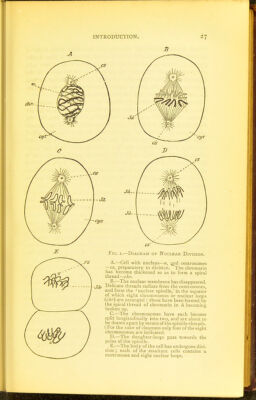
![it immediately breaks up, and becomes scattered in the form of minute granules in the delicate nuclear network, so that finally a nucleus is formed of exactly the same structure as that with which we started. Similar stages to those which occur in the aggregation of the chromatin substance in the mother-nucleus preparatory to division are passed through during the separa- tion of the daughter-nuclei, but in the reverse order. It is evident, as Wilhelm Roux was the first to point out, that the whole complex but wonderfully exact apparatus for the division of the nucleus exists for the purpose of dividing the chromatin substance in a fixed and regular manner, not merely quantitatively, but allso in respect of the different qualities which must be contained in it. So complicated an apparatus would have been unnecessary for the quantitative division only: if, however, the chromatin substance is not uniform, but is made up of several or many different qualities, each of which has to be divided as nearly as possible into halves, or accord- ing to some definite rule, a better apparatus could not be devised for the purpose. On the strength of this argument, we may therefore represent the hereditary substance as consisting of different' qualities! The same conclusion is arrived at on purely theoretical grounds, as will be shown later on when we follow out the consequences of the process of amphimixis. For the present it is sufficient to show that the complex mechanism for cell-division exists practically for the sole pur- pose of dividing the chromatin, and that thus the latter is without doubt the most important portion of the nucleus. Since, therefore, the hereditary substance is contained within the nucleus, the chromatin must be the hereditary substance. De Vries's objection to this view is, in my opinion, only an apparent one; for it has not been asserted that ' the nucleus alone is the bearer of the hereditary characters,' as de Vries thinks, but that the nucleus alone contains the hereditary sub- stance] or that substance which is capable of determining not only the character of a particular cell, but also that of its descendants. This is never contained in the cell-body, but always in the nucleus in multicellular organisms, and doubtless the same holds good for unicellular beings. It is quite possible that in certain lower Algte a few of the structures in the cell- such as vacuoles and chlorophyll bodies—pass directly from the egg-cell into the daughter-cells, although this cannot by any](https://iiif.wellcomecollection.org/image/b21293776_0056.jp2/full/800%2C/0/default.jpg)


 No text description is available for this image
 No text description is available for this image
 No text description is available for this image