Report from the Select Committee on the Vaccination Act (1867) : together with the proceedings of the Committee, minutes of evidence, appendix and index.
- Great Britain. Parliament. House of Commons. Select Committee on Vaccination Act (1867)
- Date:
- 1871
Licence: Public Domain Mark
Credit: Report from the Select Committee on the Vaccination Act (1867) : together with the proceedings of the Committee, minutes of evidence, appendix and index. Source: Wellcome Collection.
Provider: This material has been provided by Royal College of Physicians, London. The original may be consulted at Royal College of Physicians, London.
39/558 (page 15)
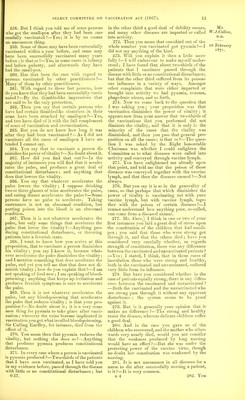
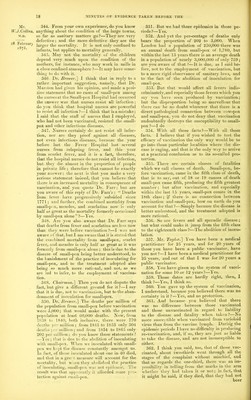
![258. But I think you told me of some persons who got the small-pox after they had been suc- cessfully vaccinated?—’Yes; it is by no means an uncommon thing. 259. Some of those may have been successfully vaccinated within a year before, and some may have been successfully vaccinated many years before ; is that so ?—Yes, in some cases in infancy and before puberty, and afterwards they have had the small-pox. 260. Has that been the case with regard to persons vaccinated by other practitioners ?— Many of them by other practitioners. 261. With regard to those last persons, how do you knoAvthat they had been successfully vacci- nated ?—By the thimble-like impressions that are said to be the Only protection. 262. Then you say that certain persons who have had certain thimble-like cicatrices in their arms have been attacked by small-pox?—Yes, and two have died of it with the full complement of scars of vaccination and re-vaccination. 263. But you do not know how long it was after they had been vaccinated? — As 1 did not vaccinate all the cases of small-pox I have at- tended I cannot say. 264. You say that to vaccinate a person di- minishes his power of vitality ?—No doubt about it. 265. How did you find that out?—In the majority of instances you will find that it accele- rates the pulse, and produces a great deal of constitutional disturbance; and anything that does that lowers the vitality. 266. You say that whatever accelerates the pulse lowers the vitality ; I suppose drinking- two or three glasses of wine accelerates the pulse, and eating dinner accelerates the pulse ?— Some persons have no pulse to accelerate. Taking sustenance is not an abnormal condition, but putting poison into the blood is an abnormal condition. 267. Then it is not whatever accelerates the pidse, but only some things that accelerate the pulse that Sower the vitality ?—Anything pro- ducing constitutional disturbance, or throwing patients into a feverish state. 268. I want to know how you arrive at this proposition, that to vaccinate a person diminishes his vitality; you say I know it, because what- ever accelerates the pulse diminishes the vitality; and I mention something that does accelerate the pulse, and yet you tell me that that does not di- minish vitality ; how do you explain that ?—I am not speaking of food now; I am speaking of blood- poisoning ; anything that keeps up irritation and produces feverish symptoms is sure to accelerate the pulse. 269. Then it is not whatever accelerates the pulse, but any blood-poisoning that accelerates the pulse that reduces vitality ; is that your pro- position ?—No doubt about it; it is a very com- mon thing for pyoemia to take place after vacci- nation ; wherever the veins become implicated in vaccination you get what is called blood-poisoning. Sir Culling Eardley, for instance, died from the effect of it. 270. You mean then that pyoemia reduces the vitality, but nothing else does so?—Anything that produces pyoemia produces constitutional disturbance. 271. In every case where a person is vaccinated is pyoemia jiroduced ?—Two-thirds of the patients that I have seen vaccinated, as I have told you in my evidence before, passed through the disease with little or no constitutional disturbance ; but 0.37. in the other third a good deal of debility occurs, and many other diseases are imparted or called into activity. 272. Then you mean that one-third out of the whole number you vaccinated got pyoemia?—I did not say anything of the kind. 273. Will you explain it then a little more fully ?—I will endeavour to make myself under- stood ; I have found that about two-thirds of the patients that I vaccinate passed through the disease with little or no constitutional disturbance; but that the other third suffered from its poison- ous influence in a variety of ways. Amongst other complaints that were either imparted or brought into activity we had pyoemia, eczema, phagedenic ulcers, and so forth. 274. Now we come back to the question that I was asking you; your proposition Avas that vaccination diminishes the power of vitality ; it appears now from your answer that two-thirds of the Araccinations that you performed did not diminish the vitality, and that it is only in the minority of the cases that the vitality was diminished, and then you pass that general pro- position on all the cases; is that so ?—The ques- tion I Avas asked by the Bight honourable Chairman Avas whether I could enlighten the Committee as to what diseases Avere called into activity and conveyed through vaccine lymph. 275. You have enlightened me already upon that point, and told me that the poison of those diseases ivas conveyed together with the vaccine lymph, and that then the diseases ensued ?—Not ahvays. 276. But you say it is so in the generality of cases, so that perhaps that Avliich diminishes the power of vitality is vaccinating not Avith pure vaccine lymph, but Avith vaccine lymph, toge- ther with the poison of certain diseases ?—I cannot understand how anything pure, so-called, can come from a diseased animal. 277. Mr. Cave.] I think in one or tAVO of your first instances you laid a great deal of stress upon the constitution of the children that had small- pox ; you said that those Avho Avere strong got through it, and that the others died ; have you considered very carefully whether, as regards strength of constitution, there Avas any difference betAveen the vaccinated and unvaccinated patients ? —Yes ; I stated, I think, that in those cases of inoculation those Avho Avere strong and healthy, both in the vaccinated and unvaccinated, suffered very little from its influence. 278. But have you considered whether in the case of patients equally strong, there is any differ- ence betAveen the vaccinated and unvaccinated ? —Both the vaccinated and the unvaccinated Avho are strong pass through it Avithout any apparent disturbance ; the system seems to be proof against it. O f , , , 279. But is it generally your opinion that it makes no difference ?-—The strong and healthy resist the disease, AV’hereas delicate children suffer a good deal. 280. And in the case you gave us of the children Avho recovered, and the mother avIio after- Avards very nearly died, would you not consider that the Aveakness produced by long nursing Avould have an effect?—But she Avas under the protecting power of the vaccine virus, though no doubt her constitution was Aveakened by the nursing. 281. It is not uncommon in all diseases for a nurse to die after successfully nursing a patient, is it?—-It is very common. B 4 Mr. W .J. Collins, M.D. 28 February 1871. 282. You](https://iiif.wellcomecollection.org/image/b24975424_0039.jp2/full/800%2C/0/default.jpg)