Report from the Select Committee on the Vaccination Act (1867) : together with the proceedings of the Committee, minutes of evidence, appendix and index.
- Great Britain. Parliament. House of Commons. Select Committee on Vaccination Act (1867)
- Date:
- 1871
Licence: Public Domain Mark
Credit: Report from the Select Committee on the Vaccination Act (1867) : together with the proceedings of the Committee, minutes of evidence, appendix and index. Source: Wellcome Collection.
Provider: This material has been provided by Royal College of Physicians, London. The original may be consulted at Royal College of Physicians, London.
42/558 (page 18)
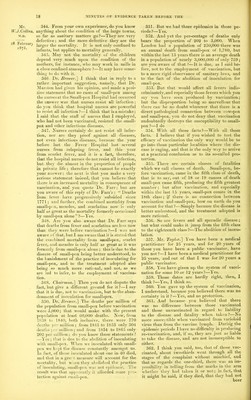
![Mr. W.J .Collins, m.d, 28 February J87I, 344. From your own experience, do you know anything about the condition of the large towns, so far as sanitary matters go?—They are very defective; and the more defective they are the larger the mortality. It is not only confined to infants, but applies to mortality generally. 345. May not the mortality of the children depend very much upon the condition of the mothers, for instance, who may work in mills in a close confined atmosphere ?—It may have some- thing to do with it. 340. Dr. Brewer.] I think that in reply to a rather important suggestion, namely, that Dr. Marston had given his opinion, and made a posi- tive statement that no cases of small-pox among the nurses at the.Small-pox Hospital had occurred the answer was that nurses resist all infection; do you think that hospital nurses are powerful to resist all infection?—I think that is a mistake; I said that the staff of nurses that I employed, who had not been vaccinated, i-esisted the small- pox and other infectious diseases. 347. Nurses certainly do not resist all infec- tion, nor are they proof against all diseases, not even infectious diseases, because the year before last the Fever Hospital lost several nurses from relapsing fever, and this year from scarlet fever, and it is a fact, therefore, that the hospital nurses do not resist all infection, but they die almost in the proportion of people in private life ; therefore that cannot be exactly your answer; the next is that you make a very serious statement indeed, that you believe that there is an increased mortality in consequence of vaccination, and you quote Dr. Farr; but are you aware of this reply of Dr. Farr’s : “ Deaths from fever have progressively subsided since 1771; and further, the combined mortality from small-pox, measles, and scarlatina now is only half as great as the mortality formerly occasioned by small-pox alone”?—Yes. 348. Are you also aware that Dr. Farr says that deaths from fever and scarlatina are less now than they were before vaccination ?—I Avas not aware of that, but I am aware that it is stated that the combined mortality from small-pox, scarlet fever, and measles is only half as great as it Avas formerly from small-pox alone ; this is due to the disease of small-pox being better understood, to the banishment of the practice of inoculating for small-pox, and to the treatment adopted also being so much more rational, and not, as we are led to infer, to the employment of vaccina- tion . 349. Chairman.] Then you do not dispute the fact, but give a different ground for it?—I say that it is due, not to vaccination, but to the aban- donment of inoculation for small-pox. 350. Dr. Brewer.'] The deaths per million of the population from small-pox before vaccination Avere 3,000; that would make Avith the present population at least 60,000 deaths. Now, from 1838 to 1840, both inclusive, there Avere 770 deaths per million ; from 1841 to 1853 only 304 deaths per million; and from 1854 to 1865 only 202 per million; do you knoAV those statements ? —Yes ; that is due to the abolition of inoculating with small-pox. When Ave inoculated with small- pox we kept the disease constantly amongst us. In fact, of those inoculated about one in 40 died, and that in a greet measure Avill account for the mortality, but w len they abolished the practice of inoculating, small-pox was not epidemic. The result was that apparently it afforded some pro- tection against small-pox. 351. But Ave had three epidemics in those pe- riods ?—Yes. 352. And yet the per-centage of deaths only bears the proportion of 202 to 3,000. When London had a population of 250,000 there Avas an annual death from small-pox of 1,780, but AA'itliinthe last 13 years there is an average death in a population of nearly 3,000,000 of only 759; are you aware of that 1—It is due, as I said be- fore, not to the employment of vaccination, but to a more rigid observance of sanitary Lavs, and to the fact of the abolition of inoculation for small-pox. 353. But that would affect all fevers indis- criminately, and especially those fevers which you say you haAre seen produced by vaccination; but the disproportion being so marvellous that there can be no doubt whatever that there is a direct pathological connection between coAV-pox and small-pox, you do not deny that vaccination undoubtedly destroys the susceptibility to small- pox ?—I do. 354. With all those facts?—With all those facts. I believe that if you Avished to test the efficacy of vaccination the only Avay would be to go into those particular localities where llie dis- ease is raging, and that is the only Avay to arrive at a practical conclusion as to its so-called pro- tection. 355. There are certain classes of fatalities which Ave call classes of death. Small-pox, be- fore vaccination, came in the fifth class of death, that is to say, out of 18 or 19 causes of death small-pox came fifth, producing the fifth greatest number; but after vaccination, and especially within the last 15 years, small-pox comes in the 18th class; if there is no connection between vaccination and small-pox, Iioav on earth do you account for that ?—Simply because the disease is better understood, and the treatment adopted is more rational. 356. So are fevers and all sporadic disease; but Avhat could make it jump from the fifth class to the eighteenth class ?—The abolition of inocu- lation. 357. Mr. Taylor.'] You have been a medical practitioner for 25 years, and for 20 years of those you have been a public vaccinator, have you not ?—I have been a medical practitioner for 25 years, and out of that I was for 20 years a public Araccinator. 358. You have given up the system of vacci- nation for some 10 or 12 years?—1 es. 359. Those dates are hardly right, then, I think ?—Yes, I think so. 360. You gave up the system of vaccination, I understand, because you believed there Avas no certainty in it ?—Yes, and no protection. 361. And because you believed that there was no difference betAveen those vaccinated and those unvaccinated in regard to liability to the disease and fatality Avhen taken ?—No more susceptible when vaccinated from varioloid virus than from the vaccine lymph. During the epidemic periods I have no difficulty in producing re-vaccination, and, if so, they are just as liable to take the disease, and are not insusceptible to either. 362. I think you said, too, that of those vac- cinated, about two-thirds Avent through all the stages of the complaint without mischief, and that as regards the one-third, there Avas an im- possibility in telling from the marks in the arm whether they had taken it or not; in fact, that it might be said, if they died, that they had not beer](https://iiif.wellcomecollection.org/image/b24975424_0042.jp2/full/800%2C/0/default.jpg)