Report from the Select Committee on the Vaccination Act (1867) : together with the proceedings of the Committee, minutes of evidence, appendix and index.
- Great Britain. Parliament. House of Commons. Select Committee on Vaccination Act (1867)
- Date:
- 1871
Licence: Public Domain Mark
Credit: Report from the Select Committee on the Vaccination Act (1867) : together with the proceedings of the Committee, minutes of evidence, appendix and index. Source: Wellcome Collection.
Provider: This material has been provided by Royal College of Physicians, London. The original may be consulted at Royal College of Physicians, London.
66/558 (page 42)
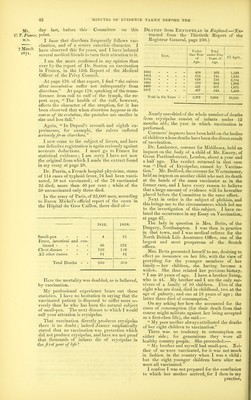
![jyrr< day last, before this Committee on this C. T. Pearce, point. M*D* I know that diarrhoea frequently follows vac- “ cination, and of a severe enteritic character. I 7 Marcli ]iave observed this for years, and I have induced 1 ^71 • several medical friends to turn their attention to it. I am the more confirmed in my opinion than ever by the report of Dr. Seaton on vaccination in France, in the 12th Report of the Medical Officer of the Privy Council. At page 176 of that report, I find “the calves after inoculation suffer not infrequently from diarrhoea.'’'’ At page 178, speaking of the trans- ference from calf to calf of the lymph, the re- port says, “ The health of the calf, however, affects the character of the eruption, for it has been observed that when diarrhoea happens in the course of its evolution, the pustules are smaller in size and less full.” Again, “ In Depaul’s seventh and eighth ex- periments, for example, the calves suffered seriously from diarrhoea. ” I now come to the subject of fevers, and here our defective registration is again seriously against accurate deductions. I must go to France for statistical evidence; I am sorry I have not now the original from which I made the extract found in my essay at page 28. Dr. Perrin, a French hospital physician, states of 114 cases of typhoid fever, 76 had been vacci- nated, 38 not vaccinated; of the 76 vaccinated 35 died, more than 40 per cent. ; while of the 38 unvaccinated only three died. In the army of Paris, of 25,000 men, according to Baron Michel’s official report of the cases in the Hdpital du Gros Caillou, there died of— 1816. 1838. Small-pox ... Fever, intestinal and con- tinued - 4 21 46 276 Chest disease - 159 159 All othei causes 41 41 Total Deaths - - 250 5C9 Here the mortality was doubled, as is believed, by vaccination. My professional experience bears out these statistics. I have no hesitation in saying that the vaccinated patient is disposed to suffer more se- verely than he who has been the natural subject of small-pox. The next disease to which I would call your attention is erysipelas. That vaccination directly produces erysipelas there is no doubt; indeed Jenner emphatically stated that no vaccination was protective which did not produce erysipelas, and have we not proof that thousands of infants die of erysipelas in the fi rst year of life ? Deaths from Erysipelas in England.—(Ex- tracted from the Thirtieth Report of the Registrar General, page 230.) Year. Under One Year of Age. Total under Five Years of Age. All Ages. 1862 .... 458 563 1,523 1863 ... . 612 745 1,920 1864 .... 618 733 2,104 1865 .... 579 682 1.963 1866 .... 527 687 1,675 1867 - 467 544 1,450 Total in Six Years - - 3,261 3,904 10,635 Nearly one-third of the whole number of deaths from erysipelas consist of infants under 12 months old; the year in which vaccination is performed. Coroners’ inquests have been held on the bodies of children whose deaths have been the direct result of vaccination. Dr. Lankester, coroner for Middlesex, held an inquest on the body of a child of Mr. Emery, of Great Portland-street, London, about a year and a half ago. The verdict returned in that case was “ Died of Erysipelas, caused by Vaccina- tion.” Mr. Bedford, the coroner for Westminster, held an inquest on another child who met its death at the hands of the same vaccinator as in the former case, and I have every reason to believe that a large amount of evidence will be hereafter placed before the Committee to the same effect. Next in order is the subject of phthisis, and this brings me to the circumstances which led me to the investigation of this subject, I have re- lated the occurrence in my Essay on Vaccination, at page 67. The lady in question is Mrs. Betts, of the Drapery, Northampton. I was then in practice in that town, and I was medical referee for the North British Life Assurance Office, one of the largest and most prosperous of the Scotch offices. Mrs. Betts presented herself to me, desiring to effect an insurance on her life, with the view of providing for the younger members of her family — her children, she having become a widow. She thus related her previous history. “ I am 40 years of age. I have a brother living, who is 44. My brother and I are the only sur- vivors of a family of 10 children. Five of the eight who are dead, died in childhood, two at the age of puberty, and one at 18 years of age ; the latter three died of consumption.” On my asking her how she accounted for the cases of consumption (for their death from that course might militate against her being accepted as a first-class life), she said :— “ My poor mother always attributed the deaths of her eight children to vaccination.” There was no tendency to consumption on either side; for generations they were all healthy country people. She proceeded:— “ My brother and myself had small-pox. Nei- ther of us were vaccinated, for it was not much in fashion in the country when I was a child; but the eight younger children born after me were all vaccinated.” I confess I was not prepared for the conclusion to which her mother arrived,' for I then in my practice,](https://iiif.wellcomecollection.org/image/b24975424_0066.jp2/full/800%2C/0/default.jpg)