Text-book of botany : morphological and physiological / by Julius Sachs ; translated and annotated by Alfred W. Bennett ; assisted by W.T. Thiselton Dyer.
- Date:
- 1875
Licence: Public Domain Mark
Credit: Text-book of botany : morphological and physiological / by Julius Sachs ; translated and annotated by Alfred W. Bennett ; assisted by W.T. Thiselton Dyer. Source: Wellcome Collection.
Provider: This material has been provided by the Royal College of Physicians of Edinburgh. The original may be consulted at the Royal College of Physicians of Edinburgh.
830/880 page 814
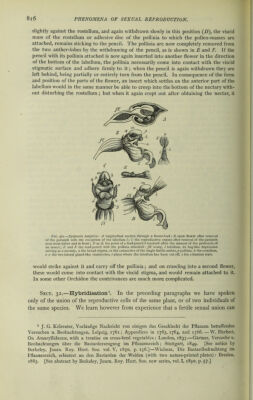
![the mechanical contrivance for preventing self-fertilisation and for ensuring crossing1 is extremely beautiful and easy to understand. Fig. 459 represents a flower of S.pratensis seen from the side ; at n is the two-lipped stigma in a receptive condition ; and indicated by a dotted line inside the upper lip of the corolla is the position of one of the two sta- mens. If a pin is inserted into the tube of the corolla in the direction of the arrow, the two stamens spring out, as indicated at a; if a humble-bee inserts its proboscis in order to obtain the honey, the open anthers strike the back of the insect, and some of the pollen adheres to a particular part; when the bee places itself in the same position in FIG. 459.—Salvia pratensis: a corolla with stigmas n and fertile anther-lobes a ; B stamens removed from corolla. another flower, the pollen is rubbed off its back on to the stigma. The cause of the stamen springing out in this way is made sufficiently clear in Fig. 459 B. This shows the short true filaments ff which adhere by their bases to the sides of the corolla-tube, and bear at their upper end the long connective cx, which oscillates readily about its point of attachment. Only the upper longer and slender arm of each connective c bears an anther-lobe a, the lower shorter arm x is without an anther, and is applied to that of the other stamen in such a manner that the two form together a kind of arm-chair. When the proboscis of the bee in search of honey penetrates the flower in the direction of FIG. 460.—Viola tricolor: A longitudinal section through the flower (natural size); B the ovary fertilised and swollen; the filaments have been ruptured and the anthers drawn up by the growth of the ovary; C the stigma with its orifice o and lip //, on the style gr (magnified); l sepals, Is prolonged base of the sepals, c petals, cs spur of the inferior petals or nectary; fs appendages of the two inferior stamens projecting into the spur, which secrete the nectar, a the anthers, n stigma, v bracts; D horizontal section through the ovary with the three placentas sp and ovules sK\ E horizontal section through an unripe anther. the arrow, the lower arm of the connective is pressed down, and the upper arm c is made to move forward, and thus to strike the back of the insect. In the pansy (Viola tricolor) we have quite]a different contrivance for preventing the possibility of self-fertilisation. In Fig. 460, A and B, is shown the position and arrange- ment of the parts of the flower. The cavity of the flower enclosed by the petals is completely filled up by the anthers and ovary, with the exception of the tubular spur of 1 For further details, see Hildebrand, Jahrb. fur wiss. Bot. vol. IV, 1865, p. 1.](https://iiif.wellcomecollection.org/image/b21981437_0830.jp2/full/800%2C/0/default.jpg)