Text-book of botany : morphological and physiological / by Julius Sachs ; translated and annotated by Alfred W. Bennett ; assisted by W.T. Thiselton Dyer.
- Date:
- 1875
Licence: Public Domain Mark
Credit: Text-book of botany : morphological and physiological / by Julius Sachs ; translated and annotated by Alfred W. Bennett ; assisted by W.T. Thiselton Dyer. Source: Wellcome Collection.
Provider: This material has been provided by the Royal College of Physicians of Edinburgh. The original may be consulted at the Royal College of Physicians of Edinburgh.
832/880 page 816
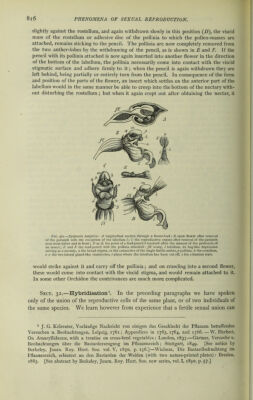
![slightly against the rostellum, and again withdrawn slowly in this position (D), the viscid mass of the rostellum or adhesive disc of the pollinia to which the pollen-masses are attached, remains sticking to the pencil. The pollinia are now completely removed from the two anther-lobes by the withdrawing of the pencil, as is shown in E and F. If the pencil with its pollinia attached is now again inserted into another flower in the direction of the bottom of the labellum, the pollinia necessarily come into contact with the viscid stigmatic surface and adhere firmly to it; when the pencil is again withdrawn they are left behind, being partially or entirely torn from the pencil. In consequence of the form and position of the parts of the flower, an insect which settles on the anterior part of the labellum would in the same manner be able to creep into the bottom of the nectary with- out disturbing the rostellum ; but when it again crept out after obtaining the nectar, it FIG. 461.—Epipactis latifolia: A longitudinal section through a flower-bud ; B open flower after removal of the perianth with the exception of the labellum /; C the reproductive organs after removal of the perianth seen from below and in front; D as B, the point of a lead-pencil b inserted after the manner of the proboscis of an.insect; E and F the lead-pencil with the pollinia attached - fK ovary, / labellum, its bag-like depression serving as a nectary, n the broad stigma, cn the connective of the single fertile anther, / pollinia, h the rostellum, x x the two lateral gland-like staminodes, i place where the labellum has been cut off, x the columnar style. would strike against it and carry off the pollinia; and on crawling into a second flower, these would come into contact with the viscid stigma, and would remain attached to it. In some other Orchideae the contrivances are much more complicated. Sect. 32.—Hybridisation1. In the preceding paragraphs we have spoken only of the union of the reproductive cells of the same plant, or of two individuals of the same species. We learn however from experience that a fertile sexual union can 1 J. G. Kolreuter, Vorlaufige Nachricht von einigen das Geschlecht der Pflanzen betreffenden Versuchen u. Beobachtungen, Leipzig, 1761; Appendices in 1763, 1764, and 1766. — W. Herbert, On Amaryllidacese, with a treatise on cross-bred vegetables; London, 1837.—Gartner, Versuche u. Beobachtungen fiber die Bastarderzeugung im Pflanzenreich; Stuttgart, 1849. [See notice by Berkeley, Journ. Roy. Hort. Soc. vol. V, 1850, p. 156.]—Wichura, Die Bastardbefruchtung im Pflanzenreich, erlautert an den Bastarden der Weiden (with two nature-printed plates): Breslau, 1865. [See abstract by Berkeley, Journ. Roy. Hort. Soc. new series, vol. I, 1850, p. 57.]](https://iiif.wellcomecollection.org/image/b21981437_0832.jp2/full/800%2C/0/default.jpg)