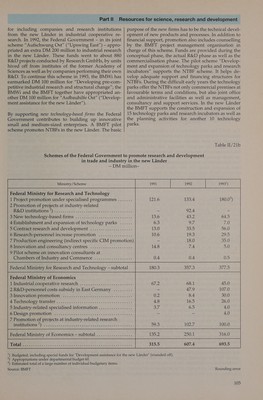
Report of the Federal Government on research 1993 : abridged version / Federal Ministry for Research and Technology.
- Germany. Bundesministerium für Forschung und Technologie
- Date:
- 1993
Licence: In copyright
Credit: Report of the Federal Government on research 1993 : abridged version / Federal Ministry for Research and Technology. Source: Wellcome Collection.
114/154 (page 110)
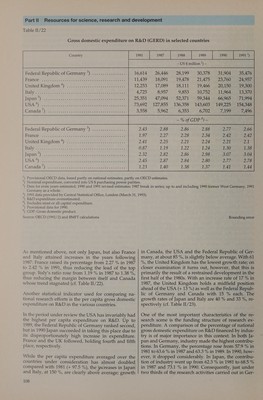
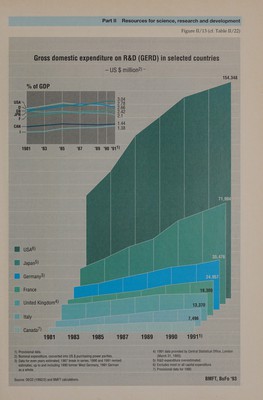
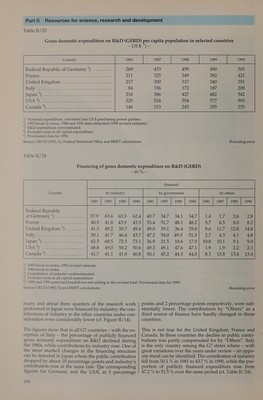
![per capita population in selected countries Nes °) R&D expenditure overestimated. *) Excludes most or all capital expenditure. °) Provisional data for 1990. Table I1/24 Rounding error: by industry Federal Republic of Germany e)igeiets. ee Pranteae sqaee eae United Kingdom ”) e [ef ese) 9110) S\-6\(e © <\s) ise 6 \0]14 isiiel «| 6 lee 0.6 @ « 6 6 60 0 © 6100 ¢ 10 © si. ‘) 1987 break in series, 1990 revised estimate. *) 1986 break in series. ') Contribution of industry underestimated. *) Excludes most or all capital expenditure. financed by government by others Source: OECD (1992/2) and BMFT calculations many and about three quarters of the research work performed in Japan were financed by industry; the con- tributions of industry in the other countries under con- sideration were considerably lower (cf. Figure H/14). The figures show that in all G7 countries — with the ex- ception of Italy — the percentage of publicly financed gross domestic expenditure on R&D declined during the 1980s, while contributions by industry rose. One of the most marked changes in the financing structure can be detected in Japan where the public contribution dropped by about 10 percentage points and industry’s contribution rose at the same rate. The corresponding figures for Germany and the USA, at 5 percentage 110 Rounding error points and 2 percentage points respectively, were sub- stantially lower. The contributions by “Others” as a third source of finance haye hardly changed in those countries. This is not true for the United Kingdom, France and Canada. In these countries the decline in public contri- butions was partly compensated for by “Others”. Italy is the only country among the G7 states where — with great variations over the years under review — an oppo- site trend can be identified: The contribution of industry fell from 50.1 % in 1981 to 43.7 % in 1990, while the pro- portion of publicly financed expenditure rose from 47.2% to 51.5 % over the same period (cf. Table II/24).](https://iiif.wellcomecollection.org/image/b32218746_0114.jp2/full/800%2C/0/default.jpg)