A manual of minor surgery and bandaging for the use of house surgeons, dressers and junior practitioners.
- Christopher Heath
- Date:
- 1862
Licence: Public Domain Mark
Credit: A manual of minor surgery and bandaging for the use of house surgeons, dressers and junior practitioners. Source: Wellcome Collection.
Provider: This material has been provided by The University of Leeds Library. The original may be consulted at The University of Leeds Library.
202/256 (page 178)
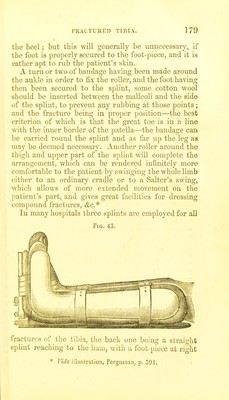
![making the patient sit up in bed, and raising the whole limb to a convenient heiglit on ]:)i]lows or a leg-rest. When all inflammatory action in the joint is past, if the patient is kept in bed, a simple splint at the back of the knee, with two straps of plaister to hold the fragments together, will answer very well; or Wood's splint may be employed, which is merely a back splint with hooks put into it, to give fixed points for the bandage to act from, and so to drag the parts together.* A broader splint than the common ones will be best for this purpose, since thus all pressure on the sides of the knee-joint Avill be avoided; and it is well to bandage the thigh carefully from above downwards, so as to counteract the action of the extensor muscles. Plaster-of-Paris and starch are particularly applica- ble to the treatment of this fracture when all active mischief has disappeared, and either of them may be applied alone, or in conjunction vnih a light wooden splint at the back of the knee. This latter method has the great advantage of enabling cases to be treated as out-patients much eai-lier than would otherwise be possible. Fractured Libia may be treated, from the first, most satisfactorily with the plaster-of-Paris or the starcb bandage. Maclntyre's iron splint is a good but rather cum- bersome method of treatment, and, unless care is taken to have the splint no broader than the limb, it is apt to shift to one side as the patient moves in bed. The splint should be slightly flexed at the knee (by means of the screw beneath), and the foot-piece made of a suitable length, and placed at rather more than a right angle to the leg-piece. It is usual to fasten a piece of bandage to the splint which is intended to go beneath](https://iiif.wellcomecollection.org/image/b21511299_0202.jp2/full/800%2C/0/default.jpg)